Complete Guide to Tile Display Solutions for Retail Showrooms 2026
Walk into any modern tile showroom and the difference is immediate. Some showrooms make it easy to see, touch, and compare dozens of tiles in minutes. Others bury their best product in flat stacks, crammed samples, and layouts that push customers back out the door.
Tile display solutions are the racks, stands, and wall systems a showroom uses to present tile upright, at eye level, so customers can see and compare finishes without bending, lifting, or digging through piles.
Tile is a visual, tactile product. Customers rarely buy a tile they cannot see upright, under good lighting, next to competing options. Yet many showrooms still present tile the way a warehouse does: flat, stacked, and nearly impossible to evaluate. The result is wasted floor space, lost sales, and a showroom that fails at its one real job, which is helping a customer choose with confidence.
The problems are familiar to every tile retailer, wholesaler, and distributor:
- Limited showroom space that cannot hold every SKU.
- Too many tile samples and no practical way to display them all.
- A poor customer experience caused by bending, lifting, and hunting through stacks.
- Difficulty comparing products side by side before a purchase.
This guide covers tile display solutions in depth: what they are, why they matter, the main types, how to design a showroom around them, and how to choose a rack that fits your business. It is written for tile manufacturers, wholesalers, distributors, showroom owners, architects, and designers who are evaluating display systems before they invest.
What Are Tile Display Solutions?
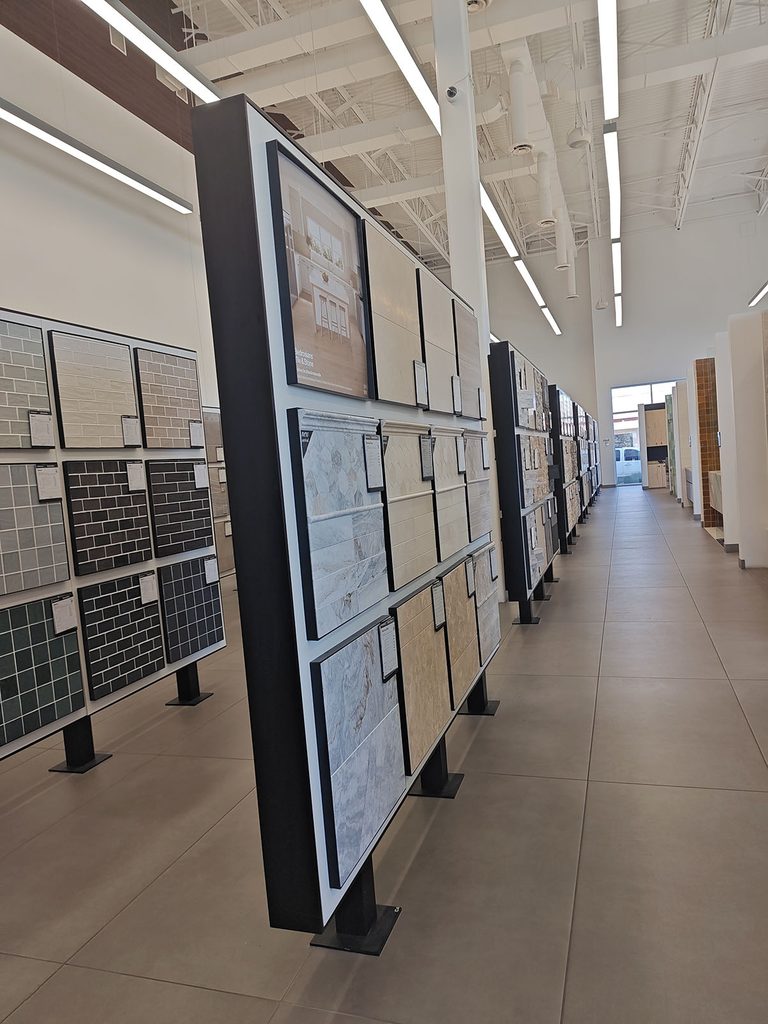
Tile display solutions are the racks, stands, and systems used to present tile products in a retail or showroom environment. They turn flat inventory into a presentation a customer can actually browse.
Tile display solutions solve one problem: tile is heavy, fragile, and made in hundreds of sizes and finishes, but a customer can only evaluate what they can see clearly. A good display system holds tile upright at viewing height, lets a customer flip through samples without lifting anything, and shows a full collection in a small footprint.
The purpose goes beyond storage. A display system is a selling tool. It organizes products, guides the customer through the range, and frames each tile in its best light. In practice, it is often the difference between a showroom that feels curated and one that feels cluttered.
In a tile retail environment, display systems do three jobs. They merchandise the product. They protect samples from damage. And they communicate brand positioning. A powder-coated steel sliding rack sends a different message than a lightweight freestanding stand, so choosing the right system is a merchandising decision as much as a practical one.
Why Tile Display Solutions Matter for Retail Showrooms
Display systems affect nearly every part of a showroom’s performance. Here is how they move the needle.
Improving customer experience. When tile is displayed upright at eye level, customers can browse without bending or lifting. Sliding racks let them pull out a panel, see the full surface, and push it back in seconds. That physical ease removes the friction that makes customers walk out without buying.
Increasing product visibility. A well-designed display system shows far more product in the same space. Where a flat stack shows one tile on top, a sliding rack can hold 20 or more panels, each visible on demand. More visible product means more chances for a customer to find what they came for and to discover something they did not plan to buy.
Maximizing showroom space. Real estate is the single largest cost for most showrooms. Display systems multiply the number of SKUs shown per square foot. A single sliding rack occupying the floor space of one large tile can present an entire collection. For distributors with hundreds of SKUs, this is the difference between a full range and a partial one.
Helping customers make purchasing decisions. Comparison drives tile sales. A customer who can see a polished, matte, and textured finish side by side, in the same light, chooses faster and with more confidence. Display systems are built for exactly this: structured, side-by-side comparison.
Strengthening brand image. The presentation of your products reflects your brand directly. A clean, organized, consistent display system signals professionalism to architects, designers, and retail buyers. In B2B, it is often the first thing a prospective distributor or project buyer notices about how a manufacturer supports its products.
Key Takeaway: A display system is a sales tool, not furniture. It increases visibility, saves space, and shortens the customer’s decision time.
Types of Tile Display Solutions for Modern Showrooms
Different showrooms need different systems. The four main categories below cover most retail and commercial applications, with custom solutions for everything else.
Sliding Tile Display Racks
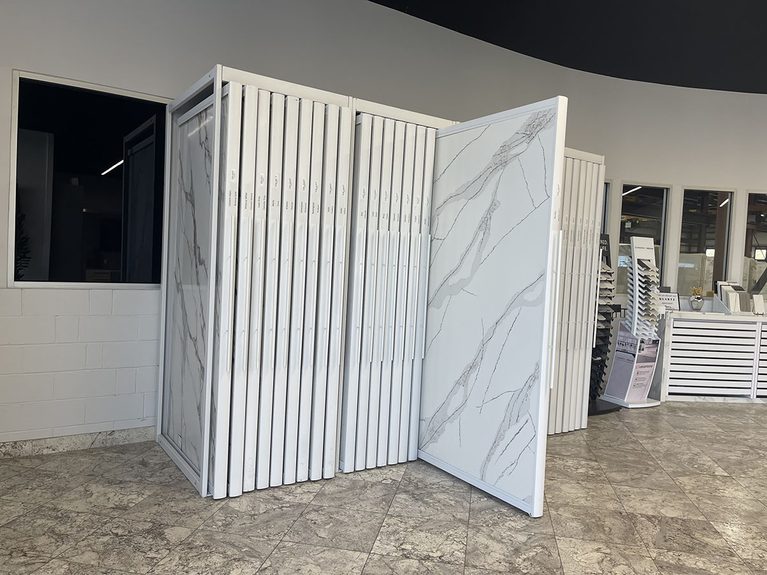
Sliding tile display racks are the workhorse of modern showrooms. They use a series of pull-out panels, each holding one or more tiles, mounted in a cabinet or frame on smooth rails. A customer pulls a panel forward, examines the tile, and slides it back.
The main advantage is space efficiency. A sliding rack can present 20 to 60 panels in the footprint of a single wall cabinet. For distributors with large catalogs, this is the most cost-effective way to show an entire range without spreading samples across the floor. If you are still deciding between rack types, our tile display rack buying guide walks through the trade-offs.
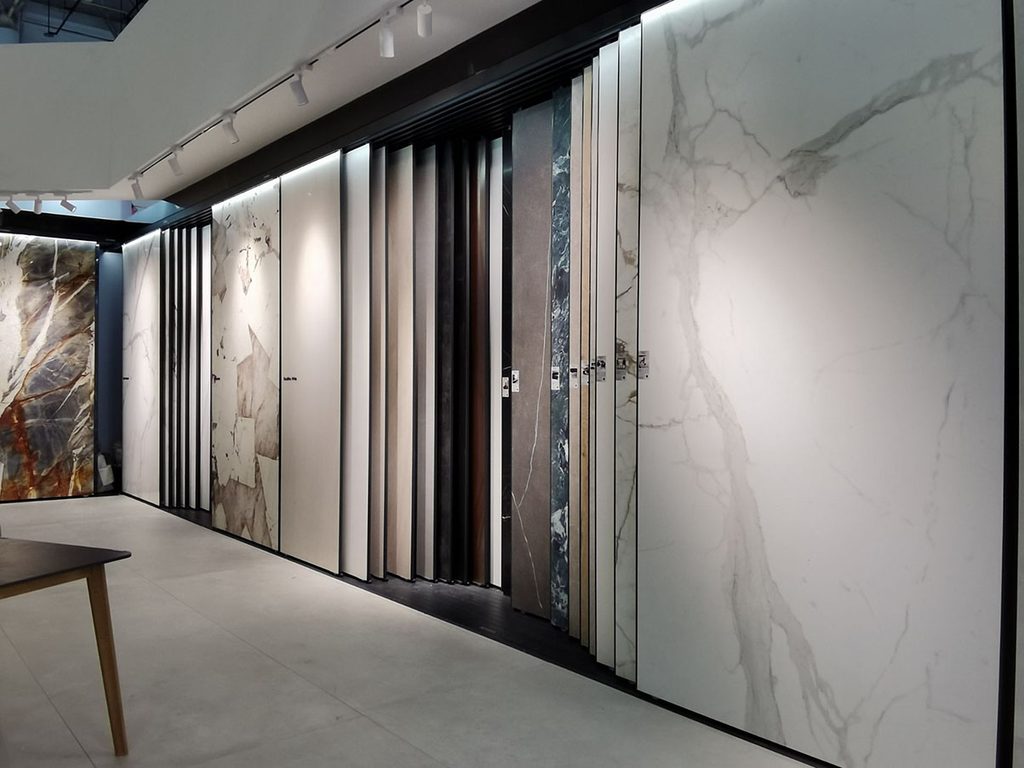
Sliding racks also protect samples. Panels keep tiles separated, preventing the scratches and chips that happen when tiles are stacked flat. Load capacity is designed for real tile weight, and a quality rack supports 30 to 50 kg per panel, enough for large-format slabs up to 900×1800 mm.
These racks suit showrooms that carry many SKUs, trade counters, and distribution showrooms where customers already know what they want and need to see finishes quickly. They are built less for browsing and more for efficient comparison.
Wall Mounted Tile Display Systems
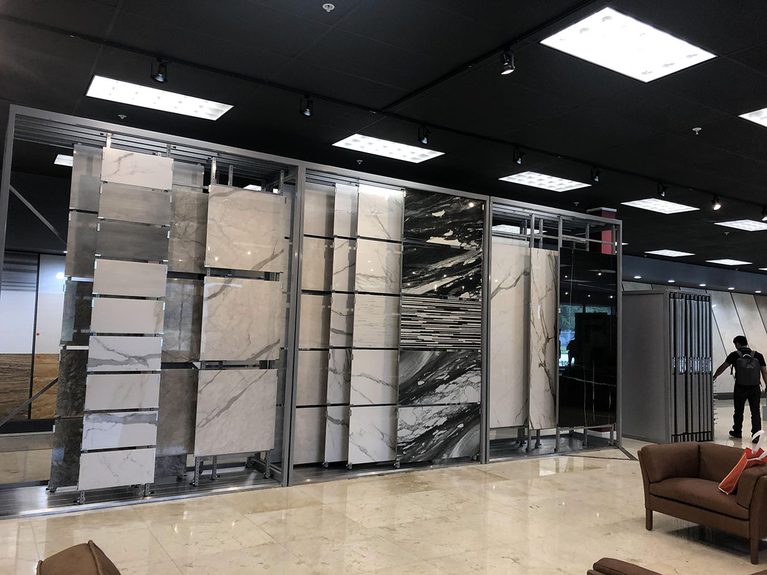
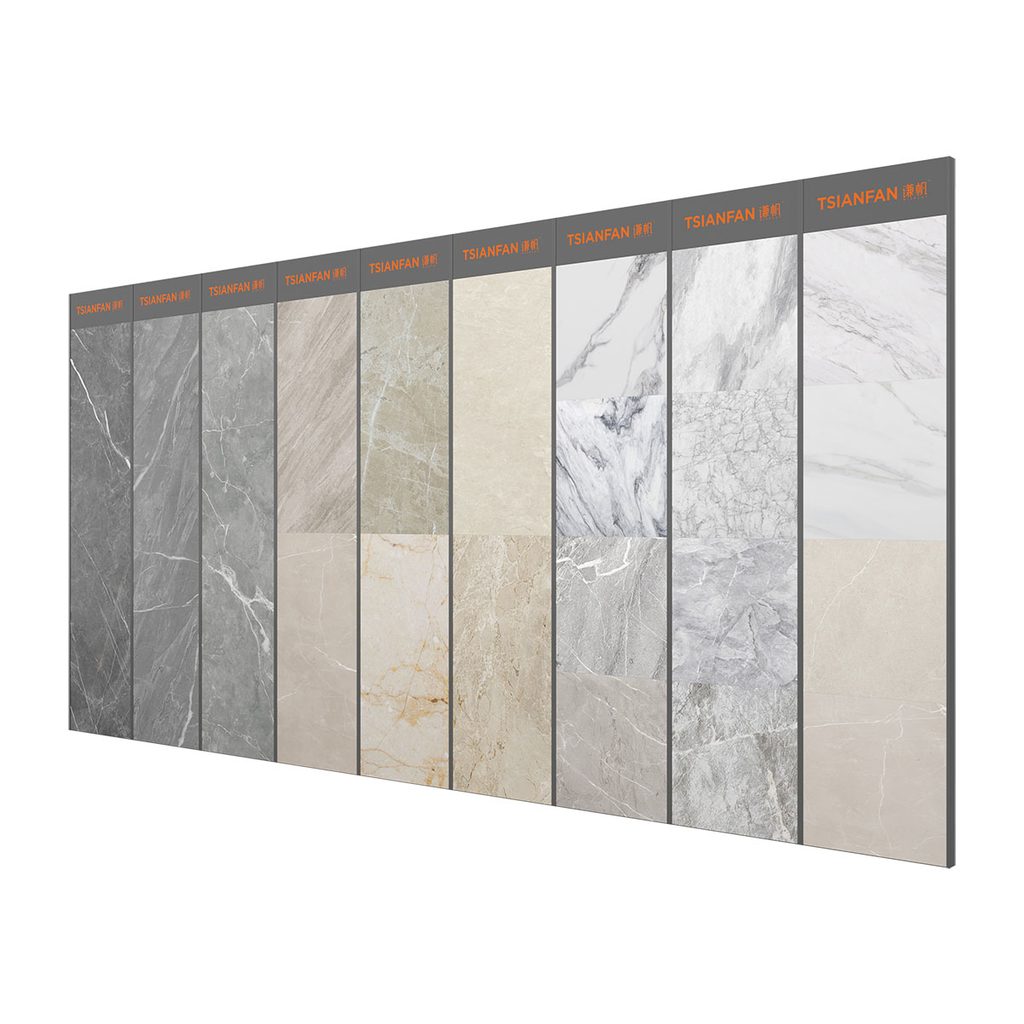
Wall mounted systems attach directly to the showroom wall, turning vertical space into display area. They keep the floor clear and draw the eye upward, which makes a small showroom feel larger.
The layout benefit is significant. Walls are almost always underused in tile showrooms. A wall mounted system adds display capacity without consuming floor space, which matters when a showroom needs room for customers to move and for large-format tiles to be viewed from a distance.
Wall systems excel at product presentation. Tile mounted at eye level, evenly lit, in a clean grid, looks its best. This is the preferred format for feature walls, new product launches, and premium collections that benefit from a gallery-style presentation. For layout ideas beyond the rack itself, see our showroom design page.
Rotating Tile Display Stands
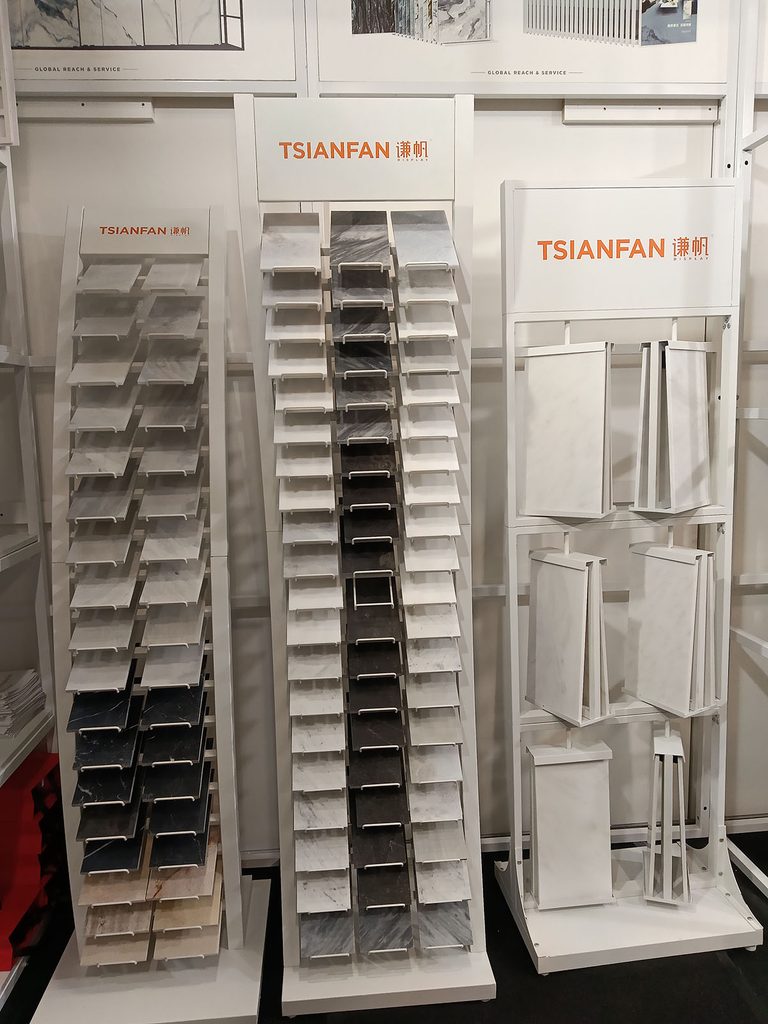
Rotating tile display stands are compact, freestanding units with spinning panels or carousels. Customers turn the stand to browse samples without walking around the showroom.
The key value is customer interaction. Rotating stands invite touch. A customer can spin the unit, stop at a tile that catches their eye, and compare it against the panel next to it. This hands-on experience keeps customers engaged longer, and engagement correlates strongly with purchase intent. Our guide on tile display stands covers what to check before you buy.
Rotating stands are ideal for entry areas, promotional zones, and spaces too small for sliding racks. They work well for medium and small-format tile and are a popular choice for distributor branches and trade events where floor space is tight and portability matters.
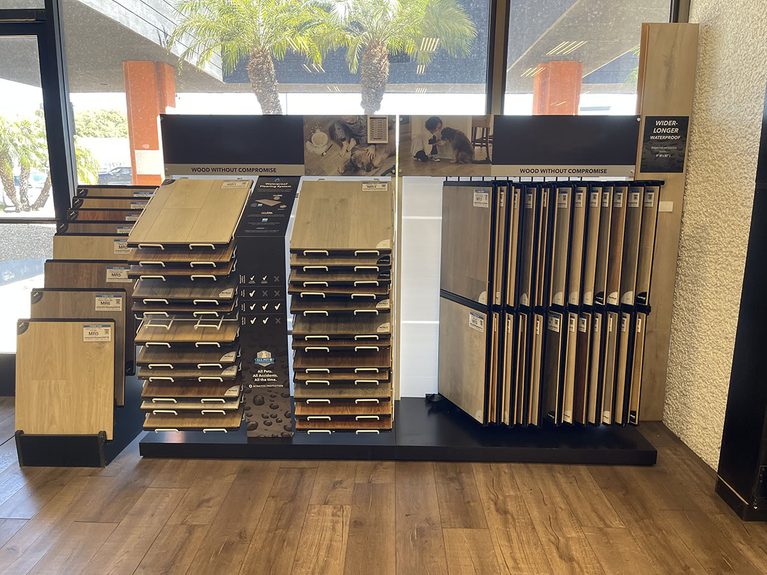
Freestanding Tile Display Racks
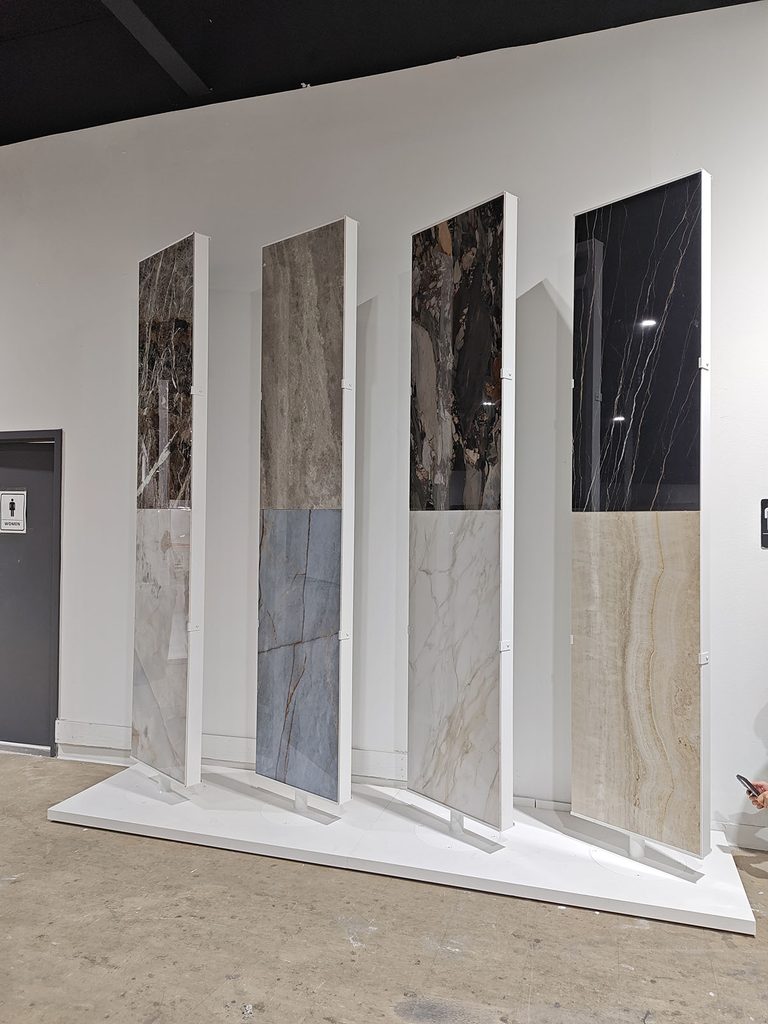
Freestanding tile display racks are self-supporting units that can be placed anywhere on the showroom floor and repositioned as needed. They are the most flexible category.
That flexibility is their main selling point. A freestanding rack can be moved to create a new display, rearranged for a seasonal promotion, or wheeled out for a trade show. No wall is required, so the showroom layout can evolve without construction.
In retail, freestanding racks serve as aisle displays, end-cap displays, and feature displays for collections on promotion. They suit building material retailers who mix tile with other products and need displays that adapt to changing floor plans.
Custom Tile Display Solutions
Custom tile display solutions are engineered around a specific brand, product range, or showroom. This is where OEM manufacturing comes in.
OEM capability lets a tile brand or distributor order display systems built to their exact specifications: panel sizes matched to their tile formats, frames finished in their brand colors, and logos applied. That is how a manufacturer turns a generic rack into a branded selling environment. You can see the range of custom tile display solutions we build, and our OEM manufacturing covers how the process works.
Customization spans three practical areas: brand identity (color, logo, signage), tile dimensions (panels sized for 300×300 mm mosaics up to 1200×2400 mm slabs), and configuration (number of panels, rotation versus sliding, wall versus freestanding). A custom system makes the display fit the product, rather than forcing the product into a standard rack.
| Display Type | Best For | Space Efficiency | Customer Interaction |
|---|---|---|---|
| Sliding rack | Large catalogs, distributors | High | Low (flip-through) |
| Wall mounted | Small or premium showrooms | Very high (uses wall) | Medium |
| Rotating stand | Entry areas, promotions | Medium | High (spin to browse) |
| Freestanding rack | Flexible retail layouts | Medium | Medium |
| Custom system | Branded OEM programs | Varies by design | Varies by design |
Key Takeaway: Match the rack type to the tile format and how the customer browses. Dense catalogs call for sliding racks; premium spaces call for wall systems; engagement zones call for rotating stands.
How to Design an Effective Ceramic Tile Showroom Layout
A display system only performs as well as the layout around it. These six factors separate a showroom that sells from one that simply stores tile.
Customer flow. Plan the route customers walk. Entry areas should hold broad appeal and promotional items. Deeper into the showroom, group products by application (kitchen, bathroom, outdoor, commercial) so customers navigate by the project they have in mind.
Product grouping. Group tile by collection, material, or finish, not by supplier. A customer comparing porcelain floor tiles wants them in one place. Mixed grouping forces them to search, which undermines the display system’s purpose.
Lighting. Tile color and texture change dramatically under different light. Use consistent, neutral lighting across comparison areas, and add accent lighting for feature walls. Natural light is ideal but inconsistent, so control it with adjustable fixtures.
Display height. Mount tile at eye level for standard formats. Large-format slabs need floor-level viewing and enough distance for a customer to step back. A common mistake is mounting everything at one height, which flattens the visual impact.
Premium product areas. Give flagship collections dedicated space, whether a feature wall, a rotating display, or a full sliding rack, separate from general stock. Premium positioning signals value before the customer reads a price tag.
Sample accessibility. Make samples easy to reach, remove, and return. Sliding panels and rotating stands reduce handling damage and keep the showroom tidy through the day.
Key Takeaway: Plan the layout before you buy racks. Customer flow, lighting, and grouping decide whether a display system actually works.
How to Choose the Right Tile Display Rack for Your Business
Selection comes down to a handful of practical factors. Work through them in order.
Showroom size. Measure usable floor and wall space first. Small showrooms benefit from wall mounted and rotating systems; larger showrooms can combine sliding racks with freestanding units. The rack must fit the space, not the other way around.
Tile dimensions. The rack must match your tile formats. Sliding panels are built for specific sizes, so verify that the panel dimensions accommodate your largest format. Large-format slabs are heavier and need reinforced rails. See our guide to porcelain slab display racks for the specifics on big formats.
Product quantity. Count your active SKUs. If you carry 300 finishes, you need high-density systems like sliding racks. If you carry 40 curated lines, freestanding or rotating displays may present them better.
Material quality. Frames should be powder-coated steel or aluminum with corrosion resistance, especially in humid showrooms. Rails and bearings must operate smoothly after thousands of cycles. Cheap plastic or thin-gauge metal will sag under real tile weight.
| Material | Strength | Corrosion Resistance | Typical Use |
|---|---|---|---|
| Powder-coated steel | High | Good | General racks, sliding systems |
| Aluminum | Medium | Excellent | Lightweight frames, humid showrooms |
| Stainless steel | High | Excellent | Premium or coastal locations |
| Engineered board panels | Medium | Low (keep dry) | Sample panels |
Load capacity. Check the rated load per panel. Underbuilt racks flex, panels stick, and tile chips. For large-format tile, confirm the system is engineered for the weight.
| Tile Format | Panel Size (mm) | Typical Load per Panel |
|---|---|---|
| Mosaic / small | 300×300 | 10–15 kg |
| Standard | 600×600 | 20–30 kg |
| Large | 800×800 | 30–40 kg |
| Slab | 1200×2400 | 40–60 kg |
Customization options. Ask whether the manufacturer can adjust panel size, finish, color, and branding. A system you can brand and resize will serve you longer than an off-the-shelf unit.
Supplier experience. Choose a manufacturer that specializes in tile display systems, not a general metal fabricator. Specialists understand tile weight, panel sizing, and the retail environment, and their stock hardware is already proven for the purpose.
Key Takeaway: Send your tile specs with your first inquiry. A qualified manufacturer will confirm panel sizes and load ratings against your formats.
Common Mistakes When Choosing Tile Display Systems
Avoid these recurring errors. They cost showrooms money and sales.
Focusing only on price. The cheapest rack is rarely the cheapest to own. Underbuilt systems bend, stick, and damage samples within a year. Total cost of ownership, covering durability, replacement, and sample damage, matters more than the initial invoice.
Ignoring durability. Tile showrooms are high-traffic environments. Displays get pulled, pushed, and spun hundreds of times a day. Bearings, rails, and hinges must be built for that duty cycle. A display that wobbles or jams on day one undermines the whole showroom.
Poor space planning. Buying racks without measuring the showroom leads to overcrowded aisles or displays that block sight lines. Plan the layout before purchasing, not after the racks arrive.
Choosing unsuitable rack types. Matching the wrong system to the wrong product is common. Large-format slabs on lightweight rotating stands will fail. Small mosaics buried on sliding panels are hard to browse. Match the rack type to the tile format and the customer’s browsing behavior.
Key Takeaway: Price, durability, space, and rack type all matter. Optimizing any one of them at the expense of the others is where most purchases go wrong.
Tile Display Solutions Trends in 2026
The display systems market is moving in five clear directions this year.
Modular showroom systems. Buyers increasingly want systems that start small and scale. Modular racks let a distributor add panels or reconfigure the layout as the catalog grows, protecting the initial investment.
Minimalist design. Clean frames, slim profiles, and neutral finishes are in. The display should recede and let the tile dominate. Heavy, ornate frames are disappearing from modern showrooms.
Interactive shopping experience. Digital elements, such as QR codes linking to technical sheets, integrated lighting controls, and touchscreen catalogs, are being combined with physical displays. The goal is a richer experience without losing the tactile inspection that sells tile.
Sustainable materials. Recycled steel, low-VOC powder coatings, and longer-life construction are growing buying criteria, driven by both brand values and procurement requirements.
Customized brand displays. More manufacturers are commissioning branded, OEM display systems as a competitive differentiator for their distributor network. A recognizable, consistent display presence is becoming part of how a tile brand wins shelf space.
Key Takeaway: Modular, minimalist, and branded. Buyers in 2026 want displays that scale, stay out of the way, and carry the brand.
Why Work With a Professional Tile Display Rack Manufacturer?
A specialist manufacturer brings capabilities a general supplier cannot match.
OEM capability. Professional manufacturers engineer displays to your specifications: panel sizes matched to your tile formats, finishes in your brand colors, and full customization of layout and signage. That turns a display into a brand asset.
Engineering support. Specialist teams understand tile weight, panel deflection, and rail duty cycles. They design systems that stay smooth and stable over years of daily use, and they can advise on layout and configuration before you order.
Quality control. Consistent manufacturing means consistent displays across every branch and distributor. Uniform finish, precise panel alignment, and reliable hardware protect your brand’s presentation everywhere it appears.
Production capacity. Established manufacturers can produce and ship volume on schedule, including large orders for distributor networks and multi-branch rollouts. Tsianfan Displays has built tile and stone display systems since 2008, with a 10,000 m² factory, five production lines, and more than 2,000 mold styles.
International shipping experience. Tile display systems ship flat-packed and heavy. A manufacturer with export experience knows how to pack systems to survive container shipping, handle customs documentation, and deliver to ports worldwide. We export to more than 80 countries and have equipped over 500 showrooms. For importers and overseas distributors, that logistics knowledge is often the deciding factor.
Key Takeaway: Choose a specialist with OEM capability and export experience, not a general fabricator. The difference shows up in load ratings, fit, and how smoothly the system lands at your port.
Frequently Asked Questions
What is the best display rack for ceramic tiles?
For most showrooms, a sliding tile display rack offers the best balance of density, protection, and customer experience. Wall mounted systems suit small or premium-focused spaces, and rotating stands work well for entry areas and promotions. The right choice depends on your tile formats, SKU count, and floor space.
How much space does a tile showroom need?
There is no fixed number. A compact distributor showroom can work in 100 to 200 square meters using wall mounted and high-density sliding systems. A full retail showroom is typically 300 square meters or more. The key is display density, meaning the number of SKUs shown per square meter, rather than raw size.
Can tile display racks be customized?
Yes. Most professional manufacturers offer OEM customization covering panel size, frame color, finish, logo, and configuration. Customization is especially valuable for brands that want a consistent display presence across their distributor network.
What materials are tile display racks made from?
Quality racks use powder-coated steel or aluminum frames for strength and corrosion resistance. Panels are typically finished steel or engineered board, with tempered glass or acrylic accents on premium units. Bearings and rails are metal for long duty cycles.
How do manufacturers ship tile display systems internationally?
Systems are shipped flat-packed to reduce volume, then assembled on site. Export manufacturers use reinforced packing designed for container shipping, provide assembly instructions, and handle export documentation and customs. Confirm the manufacturer’s export experience before ordering for overseas delivery.
How much weight can a tile display rack hold?
Load capacity varies by design. A quality sliding rack panel typically supports 30 to 50 kg, enough for most formats including large slabs. Always verify the rated capacity against your heaviest tile format before purchasing.
What is the difference between a display rack and a display stand?
A rack is generally a larger, multi-panel system, often sliding or wall mounted, for presenting many tiles. A stand is usually a smaller, freestanding or rotating unit for featuring a curated selection. The terms overlap, but racks favor density and stands favor presentation.
How long does a tile display system last?
A well-built powder-coated system with quality hardware typically lasts 8 to 10 years or more in daily showroom use. Cheaper systems may need replacement within 2 to 3 years. Durability is driven by materials and hardware quality, not just frame design.
Can I order display racks with my brand logo?
Yes. Logo application, brand-color finishing, and custom signage are standard OEM services. Branded displays are widely used by tile manufacturers to build a consistent presence in distributor and retail showrooms.
Do I need to assemble the display racks myself?
Most systems ship flat-packed with instructions and require basic on-site assembly. For large or complex installations, manufacturers can often arrange or guide professional installation. Confirm assembly requirements and support before ordering.
Conclusion
Tile display solutions are not showroom furniture. They are the sales infrastructure of a tile business and the difference between a customer who browses and a customer who buys. A well-chosen system shows more product in less space, makes comparison effortless, and communicates your brand’s professionalism to every architect, designer, and buyer who walks through the door.
Whether you need sliding racks for a 300-SKU catalog, wall mounted systems for a premium showroom, or a fully customized OEM program for your distributor network, the right display system pays for itself in faster decisions and stronger brand perception.
Contact our team for custom tile showroom display solutions.