Why Your Showroom Needs XXL Displays for Large Format Tiles
XXL displays for large format tiles are heavy-duty retail fixtures built to hold oversized porcelain slabs and tile panels upright or at a shallow angle, so a customer can see an entire sheet the way it will look installed. Most handle panels from 800×1600 mm up to 1600×3200 mm and weigh in the hundreds of kilograms when fully loaded.
Large format tile is not a passing trend. It has been climbing for a decade, and it is now the highest-margin line in most tile showrooms. A 1200×2400 porcelain slab that wholesales for $15 a square meter can retail at three or four times that, and the markup on the display hardware around it is just as good.
The problem is that most showrooms have not updated how they show it. They lean a slab against a wall on a scrap of cardboard, three deep, corners chipped. Someone eventually knocks it over and a $400 slab turns into a $0 slab. I have seen this exact thing play out. The displays are usually an afterthought, and it shows.
Why large format tiles need their own display
Standard tile racks were built for 300×600 and 600×600 tiles. They work because a 600×600 tile weighs a few kilos and a customer can flip through them like pages in a book.
A 1200×2400 slab is a different animal. It can weigh 50 to 80 kg. A 1600×3200 slab runs 100 kg or more. You cannot hand it to a customer, and you cannot hang it on the same A-frame that holds your subway tile. Trying to is how you get injured staff and cracked slabs.
So an XXL display has to do three things the old racks never had to:
- Hold the weight without sagging or tipping.
- Let one person show a full slab without lifting it.
- Keep the slab face visible and safe while people browse.
Key Takeaway: Large format slabs are too heavy for standard tile racks. A proper XXL display holds the weight, lets one person show a full sheet, and keeps the face visible without chipping corners.
What an XXL display actually is
“XXL display” covers a few different fixtures. The one you pick depends on how your showroom is laid out and how many slabs you carry.
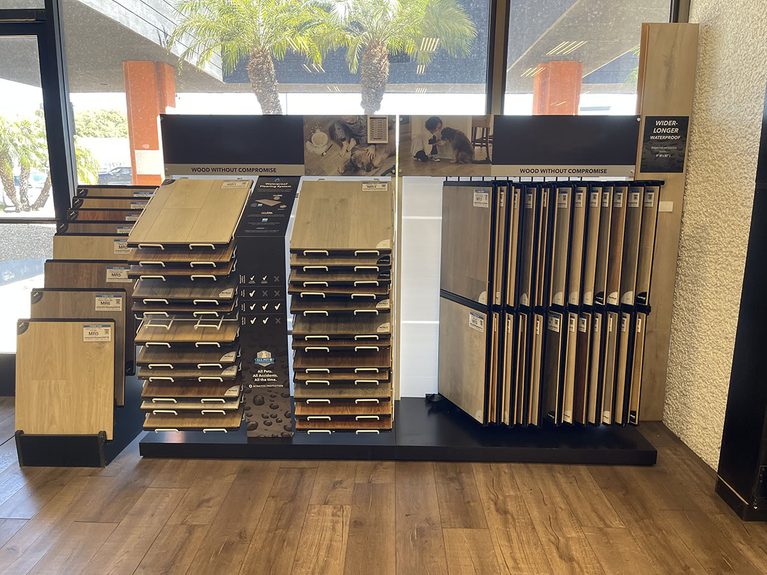
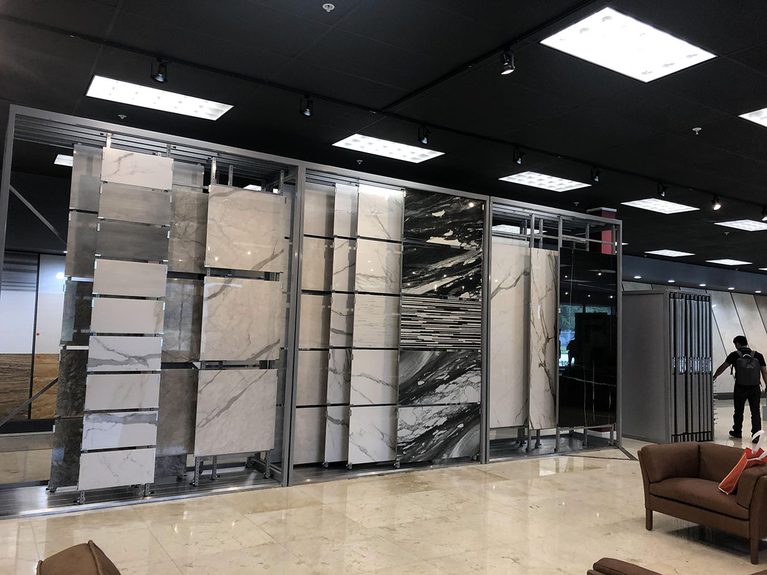
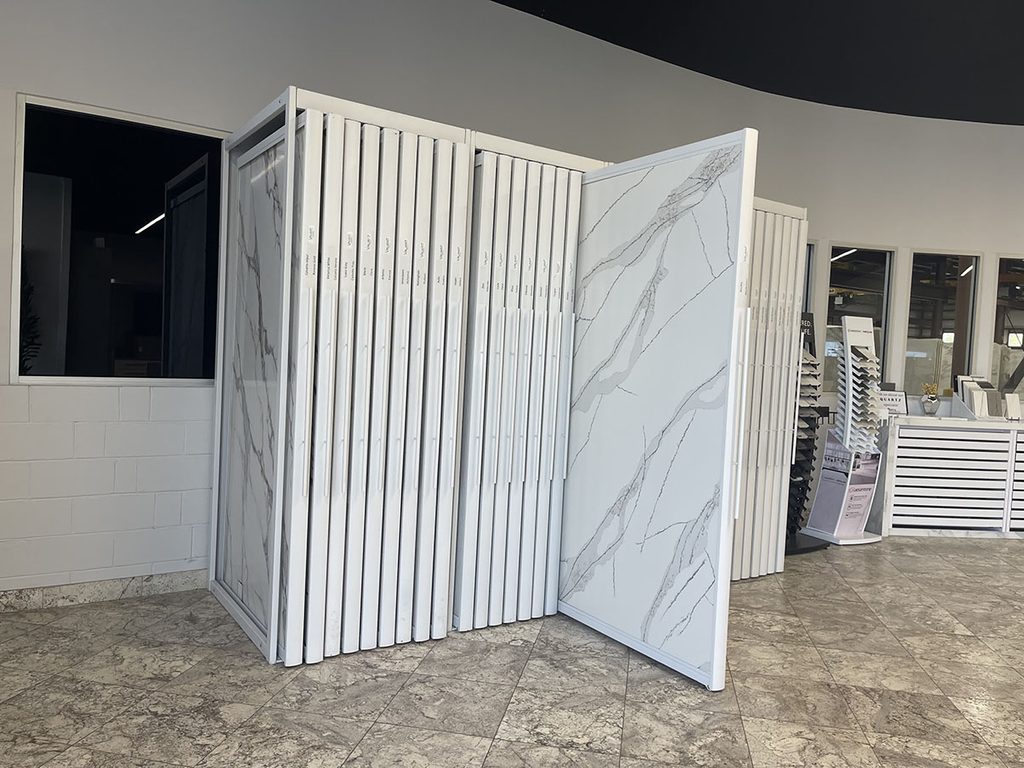
Slab A-frames (or slider racks) sit on the floor and hold slabs upright, usually on a rolling trolley or a tilt-and-slide rail so you can pull one slab out without wrestling the rest.
Wall-mounted panel displays fix a grid to the wall and let you hang slabs like framed art. Good for a feature wall, not great if you swap stock often.
Floor-standing towers and carousels hold dozens of slabs in a small footprint and rotate so a customer can browse both sides.
Freestanding easel displays angle a single large slab 10 to 15 degrees off vertical so it catches the light. These are the centerpiece, not the workhorse.
Most showrooms run a mix: a carousel or A-frame for the bulk of the range, plus one or two easels for the hero slabs. Not sure which format fits your floor plan? Our tile display rack range lays out the options side by side.
Can the rack handle the weight?
This is the question that separates real XXL displays from racks that just got relabeled.
Check the load rating. A 1200×2400 rack that claims to hold “up to 12 slabs” but has a 60 kg per-arm limit will fail the moment someone loads two 1600×3200 slabs on one side. Ask for the per-bay and total load rating in kilograms, not a slab count. Slab thickness changes the math fast: a 12 mm slab and a 20 mm slab weigh very differently.
Look at the steel, too. Powder-coated mild steel is fine indoors. If the display sits near a loading dock or gets moved often, you want thicker gauge tube and reinforced corners. A cheap rack flexes when you slide a slab out, and that flex is exactly when corners chip.
Key Takeaway: Ask for a load rating in kilograms per bay, not a slab count. If a supplier won’t give you the number, walk away.
How many slabs can it actually hold?
Manufacturers love to quote capacity as if every slab is 6 mm thick and your staff are Olympic lifters.
A carousel that holds 40 slabs at 6 mm will hold maybe 20 at 12 mm and fewer at 20 mm. If most of your range is 1200×2400×12, size the display for that and treat the 1600×3200 slabs as a bonus.
Also check the spacing between slots. Too tight and you can’t pull a slab out without scraping its neighbor. Too loose and you waste floor space. Around 60 to 80 mm between faces works for most showrooms.
Does it tilt, slide, or rotate?
How a slab moves matters as much as how it sits.
Tilt-and-slide rails let one person pull a single slab forward and angle it toward the customer without lifting its full weight. This is the feature that saves your staff’s backs and your slabs’ corners. Without it, you are back to two-person lifts for every customer who wants a closer look.
Rotating carousels do the same job from the other direction: the customer stays put and the rack turns. Either works. What you don’t want is a static rack where the slab you need is always at the back.
What it costs, and why it pays back
XXL displays are not the cheapest line in your fit-out, but they are cheaper than the alternative.
A single 1600×3200 porcelain slab retails for several hundred dollars depending on the finish. One chipped corner writes it off. If a proper display saves you two or three slabs a year, it has paid for itself, and that is before you count the sales lost to showing slabs flat on a pallet.
The other cost nobody budgets for is time. If a staff member has to find a second person every time a customer asks to see the large format range, those minutes add up across a year. A tilt-and-slide display turns that into a one-person job.
| Display type | Slab sizes it suits | Typical capacity | Best for |
|---|---|---|---|
| Slab A-frame / slider | 800×1600 to 1600×3200 | 6–20 slabs | High-turnover showrooms |
| Wall-mounted grid | 800×1600 to 1200×2400 | 4–12 panels | Feature walls, fixed range |
| Rotating carousel | up to 1600×3200 | 20–60 slabs | Small footprint, wide range |
| Freestanding easel | 1200×2400 and up | 1 slab | Hero product, photos |
Prices vary with steel thickness, finish, and shipping, which is why it’s worth quoting the same spec from two or three manufacturers rather than comparing headline prices.
Key Takeaway: A display that saves a couple of slabs a year has paid for itself, before you count faster showings and less staff lifting.
What to ask a supplier before you buy
- What’s the load rating per bay, in kilograms?
- Does it have tilt-and-slide or rotating mechanisms, and are they rated for the slab weights I carry?
- What slab thickness was the capacity quoted for?
- What steel gauge and finish? Powder-coated for indoor, or something stronger?
- Can it be flat-packed for freight, and what does shipping actually cost to my address?
- Do you have photos of it loaded with 1600×3200 slabs, not empty?
That last question filters out more suppliers than you’d expect. A display that looks great empty can be a very different object with 500 kg of porcelain hanging off it.
Frequently asked questions
What size tile counts as “large format”?
Most of the industry treats anything with one side at 800 mm or more as large format, but the term is loose. The displays here are aimed at 800×1600 mm and up, with the serious XXL hardware handling 1200×2400 and 1600×3200 slabs.
Do I need a different display for 1600×3200 slabs?
Usually yes, or at least a heavier build. Check the load rating and bay width. A rack sized for 1200×2400 often holds a 1600×3200 slab if the arms are rated for the weight, but the taller slab changes the center of gravity, so confirm with the supplier.
How heavy is a large format porcelain slab?
It depends on thickness. A 1200×2400 slab runs roughly 50 to 80 kg at 12 mm. A 1600×3200 slab at 12 mm can pass 100 kg. At 20 mm those numbers climb well past that, so always size for your thickest slab.
Can one person load and show these slabs?
With a tilt-and-slide or rotating display, yes for most 1200×2400 slabs. 1600×3200 slabs usually need two people to load, though a good mechanism lets one person present them once they’re on the rack.
Where should I put the XXL display in my showroom?
Near the front or along a main wall, where it catches natural or spot lighting. Large slabs are your highest-margin product, so they earn the best floor position. Keep them away from narrow aisles and doorways where a corner could get knocked.
Are these displays shipped assembled?
Most are flat-packed to keep freight down, then bolted together on site. Confirm packaging and weight before you commit, because freight on steel fixtures can cost more than the fixture itself on small orders.
How long do XXL displays last?
A well-built powder-coated steel display lasts a decade in normal showroom use. The moving parts (slides, casters, bearings) wear first, so ask whether those are replaceable or if you’d have to buy a whole new bay.
Planning a showroom refresh? Get in touch for a spec sheet and a quote sized to the slabs you carry.