
Porcelain Slab Display Racks: The Complete Guide for Large Format Tile Showrooms
Porcelain slab display racks are heavy-duty fixtures built to hold large format porcelain tiles and sintered stone slabs, usually 1200x2400mm up to 1600x3200mm and weighing 30 to 120kg each.
A standard tile rack was never built for these. Put a 90kg slab on an A-frame meant for 600mm wall tiles and the frame flexes, the surface scratches, or the whole thing tips. We’ve heard the story enough times: a showroom buys the cheapest rack, loads it with slabs, and a week later a customer leans one forward and it goes down. If you sell large format porcelain or sintered stone, the rack isn’t a minor purchase. Here’s what actually matters when you’re choosing one.
What is a porcelain slab display rack?
It’s a display frame built specifically for oversized, heavy slabs. The differences from a regular tile rack show up in three places: the slots are wider and deeper, the frame is reinforced, and the slab leans back against the back panel instead of standing straight. On top of that, every contact point is padded so the polished surface doesn’t get scratched.
You’ll see four main styles:
Sliding or pull-out racks. Slabs hang on panels that pull out like library drawers. These are what we recommend for showrooms that want customers to flip through a lot of slabs without taking up the whole floor.
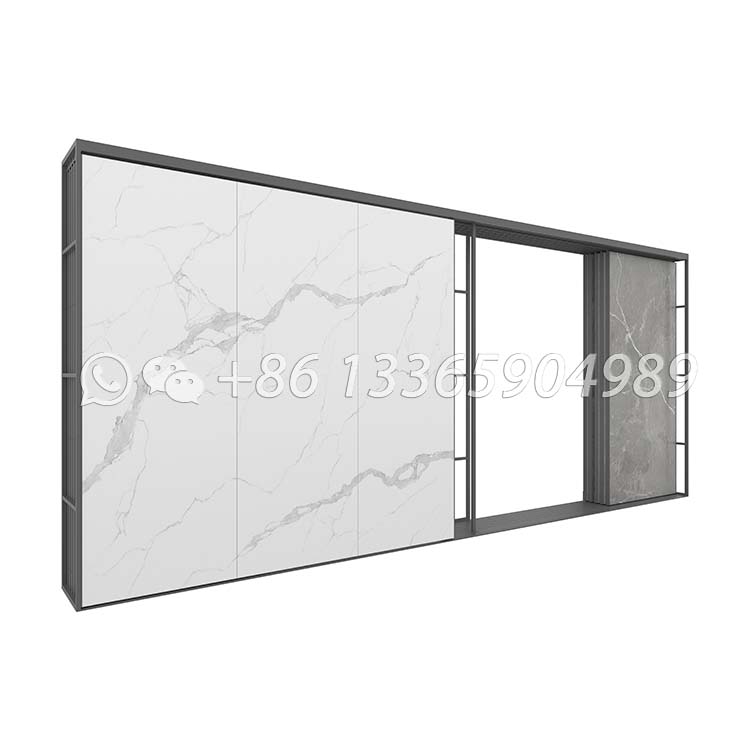
A-frame slab racks. A wide, double sided A-frame with deep slots sized for full slabs. Simple, and you can browse from both sides.
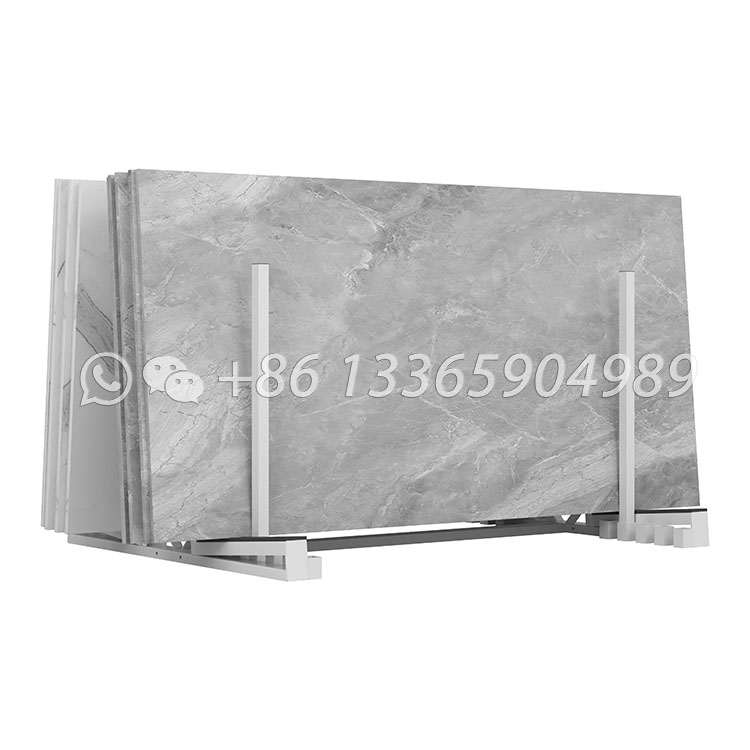
Wall lean-to racks. Slabs lean against a reinforced wall frame. Good when floor space is tight, and it doubles as a feature wall.
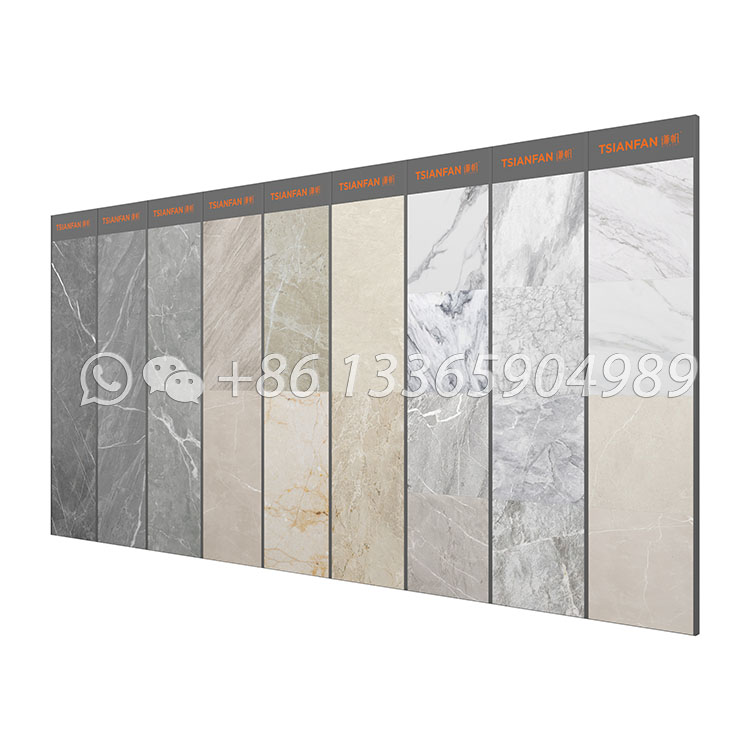
Tower slab racks. Vertical bays stacked high. This is the distributor or warehouse answer when you need volume more than presentation.
Why do large format slabs need a different rack?
It mostly comes down to weight and size.
The weight first. A 1600x3200mm slab at 12mm thick can run past 100kg. A rack rated for thin wall tiles flexes under that load, and a flexing frame is how slabs crack. I’ve seen the crack start right at the slot edge, where the slab was resting on a bar that was never meant to hold it.
Then the dimensions. Standard tile slots are sized for 600mm to 900mm panels. A 3200mm slab overhangs and sags, and the slot depth, width, and spacing all have to be designed around the full slab, not the other way around.
And the surface. Large format porcelain is usually polished and expensive, and bare metal will scratch it on contact. Slab racks put felt, rubber, or plastic separators on every point the slab touches.
Key takeaway: If a rack wasn’t rated for slabs, don’t put slabs on it. The frame, the slot size, and the surface protection all have to be built for large format.
What slab sizes should the rack hold?
Measure your biggest slab before you look at any rack. It saves you from ordering a rack that fits everything except the one slab you actually sell the most of.
The standard large formats are:
1200x2400mm and 1200x2780mm. The most common large format sizes in North America and Europe.
1600x3200mm. The biggest standard slab, used for full height cladding and countertops.
800x2600mm and 1000x3000mm. Common in some Asian markets.
Thickness runs from 6mm thin sintered stone up to 20mm full body porcelain and natural stone. A 20mm slab weighs about three times what a 6mm slab of the same size weighs, so the thickness changes the load rating you need.
Key takeaway: Send your largest slab dimensions and your thickest slab, not an average. Those two numbers define the rack.
Which rack type works best for porcelain slabs?
Depends how you sell. Here’s how the four types compare for slab use.
| Rack type | Best for | Slabs per rack | Floor or wall |
|---|---|---|---|
| Sliding / pull-out | Showrooms, browsing many slabs | 10 to 30 | Floor |
| A-frame slab rack | Two-sided floor display | 8 to 20 | Floor |
| Wall lean-to | Feature wall, small floor space | 5 to 15 | Wall |
| Tower | Distributors, warehouses | 20 to 50 | Floor |
How much weight should a slab rack hold?
Two numbers matter: the per-slot load rating and the total rack capacity.
A quality slab rack should hold 50 to 100kg per slot, depending on the design. Total capacity is the slots added up, plus a safety margin. If a rack holds 10 slabs at 80kg each, the frame should be rated for at least 900 to 1000kg total, because a customer pulling a slab partway out adds leverage the frame has to absorb.
Ask for the rated numbers in writing. A manufacturer that can’t tell you the load rating isn’t actually engineering for slabs.
How do you keep slabs from tipping?
The tilt angle does most of the work. Slab racks lean slabs back 8 to 12 degrees, so their weight presses into the frame instead of forward. Less than that and a slab can tip the moment someone pulls the one in front of it.
Beyond the tilt, you want an anti-tip design: a wide weighted base, optional floor anchors, and a frame that stays put when the top slots are full and the bottom ones are empty. If a rack wobbles when it’s empty, it’s worse when it’s loaded.
How do you stop the rack scratching the slab surface?
Polished porcelain scratches on contact with bare metal, so every point where the slab touches the rack needs a soft layer: felt strips, rubber pads, or plastic edge protectors.
Check the slot dividers too. Cheap racks rest each slab on a single metal bar, which concentrates the weight on a thin edge. A good slab rack spreads the contact across a padded channel instead.
How thick should the steel frame be?
Slab racks are steel, and the gauge matters. A standard tile rack might use 0.8 to 1.0mm steel. A slab rack needs thicker tubing and reinforced joints, because the frame is carrying several hundred kilograms, not a few boxes of wall tile.
The finish matters as much as the metal. Powder coating gives a clean, scratch resistant surface and protects against rust. If your showroom is humid or near the coast, ask for galvanized or stainless hardware at the joints. The welds are the weak point, so a good manufacturer grinds and coats them instead of leaving raw weld lines.
| Spec | Standard tile rack | Porcelain slab rack |
|---|---|---|
| Steel gauge | 0.8 to 1.0mm | 1.2 to 2.0mm reinforced |
| Per-slot load | 20 to 30kg | 50 to 100kg |
| Finish | Basic powder coat | Powder coat plus galvanized hardware |
| Surface contact | Bare metal, minimal padding | Felt or rubber on every point |
How many slabs can one rack hold?
Work backwards from your floor space and your range. A standard sliding slab rack holds 10 to 30 slabs depending on slot spacing. Deeper spacing means fewer slabs per rack but easier access.
If you stock 40 slab designs, you’ll need two or three racks, or one big tower. Resist the urge to cram slabs in to save floor space. Packed too tight, they’re hard to pull out, and customers stop bothering to look.
Can you get custom porcelain slab display racks?
Yes, and in practice most slab projects end up custom in some way. Stock racks come in fixed slot sizes, so if your slabs are a non standard size or you want a particular finish, custom is the route.
Common custom options: slot width and spacing cut to your exact slab sizes, frame color matched to your brand, your logo printed or laser cut on the header, and a modular design you can extend as your range grows. Custom means a higher minimum order and a longer lead time, so it’s worth doing when the standard sizes genuinely don’t fit.
How are slab racks shipped?
Slab racks are bulky, and the way they ship changes your landed cost. Most export racks are flat packed to save container space, then bolted together on arrival. Some fully welded units ship assembled.
Ask about export packaging: foam and corner protection on the frame, and reinforced cartons that survive a container getting moved between truck, port, and warehouse. An assembled rack that arrives bent is worthless, no matter how good it looked in the factory photo.
| Factor | Flat pack | Assembled |
|---|---|---|
| Shipping cost | Low | High |
| Container space | High efficiency | Low |
| Assembly on arrival | Required | None |
| Transit damage risk | Lower, protected | Higher, exposed |
How much does a porcelain slab display rack cost?
It varies by size, steel gauge, finish, and whether it’s custom. Instead of comparing sticker prices, compare per-slot cost and expected life. A rack that holds 20 slabs and lasts 10 years is a better deal than one that holds 20 slabs and bends in two.
Shipping is part of the price too. Flat packed racks cost far less to ship than assembled ones, so a slightly higher rack price can still land cheaper overall.
Frequently asked questions
What is a porcelain slab display rack?
A porcelain slab display rack is a reinforced display fixture built to hold large format porcelain tiles and sintered stone slabs, typically 1200x2400mm up to 1600x3200mm. It has deeper slots, a stronger frame, and a backward tilt to keep heavy slabs stable and easy to browse.
What size slabs can a porcelain slab display rack hold?
Most slab racks are built for 1200x2400mm, 1200x2780mm, and 1600x3200mm slabs. Check the rack’s maximum slot width and depth against your largest slab, and confirm the thickness range, since thicker slabs weigh more.
How much weight can a porcelain slab display rack hold?
A quality slab rack holds 50 to 100kg per slot depending on the design. Confirm both the per-slot and total load rating with the manufacturer, and make sure the frame can handle the leverage of a slab pulled partway out.
What angle should porcelain slabs lean at?
Slab racks lean slabs back 8 to 12 degrees. This angle keeps the slab’s weight pressing into the frame instead of forward, which is what stops it from tipping when a customer pulls the slab in front of it.
What material is best for a porcelain slab display rack?
Reinforced steel with a powder coated finish is the standard for slab racks. Use thicker steel tubing than a regular tile rack, and add galvanized or stainless hardware at the joints for humid or coastal showrooms.
Can I get a custom porcelain slab display rack?
Yes. Most manufacturers offer custom slot width and spacing for your exact slab sizes, custom frame colors, printed or laser cut branding, and modular designs. Custom racks typically have a higher minimum order and a longer lead time.
How are porcelain slab display racks shipped?
Most export slab racks are flat packed to save container space and then bolted together on arrival. Ask for export packaging with foam and corner protection, since an assembled rack that arrives bent cannot be used.
How do I stop the rack from scratching the slabs?
Choose a rack with felt, rubber, or plastic contact points on every surface the slab touches. Avoid racks that rest slabs on a single bare metal edge, because polished porcelain scratches on contact with metal.
What to do next
If you sell large format porcelain or sintered stone, a dedicated slab rack isn’t really optional. We’ve watched showrooms go from leaning slabs against a wall to a proper pull-out rack, and the difference is immediate: customers actually pull the slabs out and look at them. Send us your biggest slab size and your thickest slab, and we’ll come back with the right slot dimensions, load ratings, and a price.