Small Tile Showroom Design Ideas with Display Rack Solutions
A small tile showroom has to earn every square meter. There’s no room for samples piled in corners or racks that block the walking path.
A tile display rack is a store fixture built to hold tile samples at eye level so shoppers can compare finishes and sizes without digging through storage. In a compact showroom, the right rack does two jobs at once: it stores the stock and it sells it.
Most small showrooms don’t fail because they lack products. They fail because the products are hard to reach and harder to compare.
1. Plan the layout before you buy any displays
The mistake most small tile stores make is ordering racks first and fitting the room around them. It should go the other way.
Walk the floor with a tape measure. Mark where customers enter, where they naturally stop, and where the counter sits. A workable small-showroom layout needs four things:
- Clear walking paths
- Products grouped by category
- Samples at eye level
- Enough room to step back and see a full panel
Where do customers stop first?
Your entrance sells your best tiles, whether you plan it that way or not. Shoppers make up their mind about a store in the first few steps.
Put featured displays, new collections, and your highest-margin lines here. Rotating tile display stands work well because they show a lot of product in a small footprint.
How do you use the wall space?
Walls are the cheapest display area in the building, and most stores ignore them. Wall-mounted tile display racks, sample panels, and sliding systems let you add dozens of samples without touching the floor.
What goes in the center?
Keep the middle of the room open. If you need displays there, use island units, mobile racks, or rotating stands customers can walk around. A cramped center is where small showrooms start to feel claustrophobic.
2. Sliding tile display racks save the most space
If you can only change one thing in a small showroom, make it the sample storage.
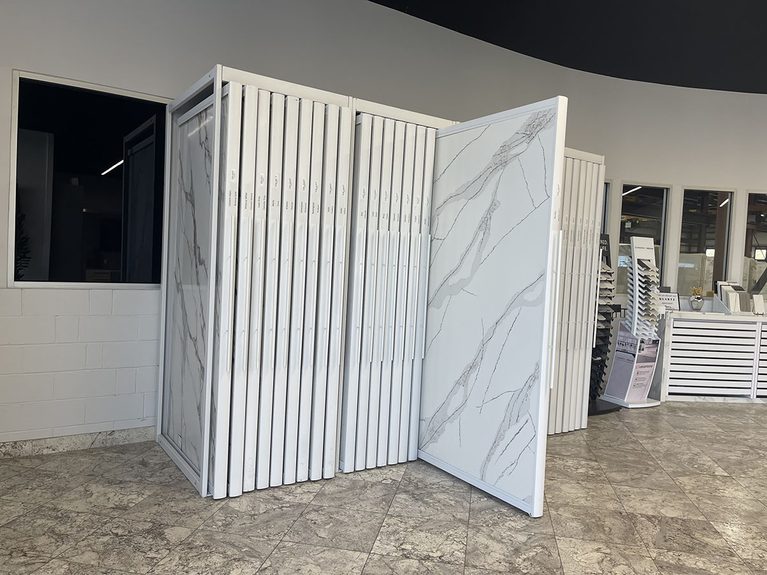
Traditional fixed displays need gaps between panels so customers can pull one out. Sliding tile display racks store panels tight together on a track. The customer slides the rack open, pulls the sample they want, and pushes it back.
A single sliding rack can hold dozens of panels in the same footprint as a few fixed ones. The samples stay organized instead of stacked in a back room, and the customer does the searching themselves in seconds.
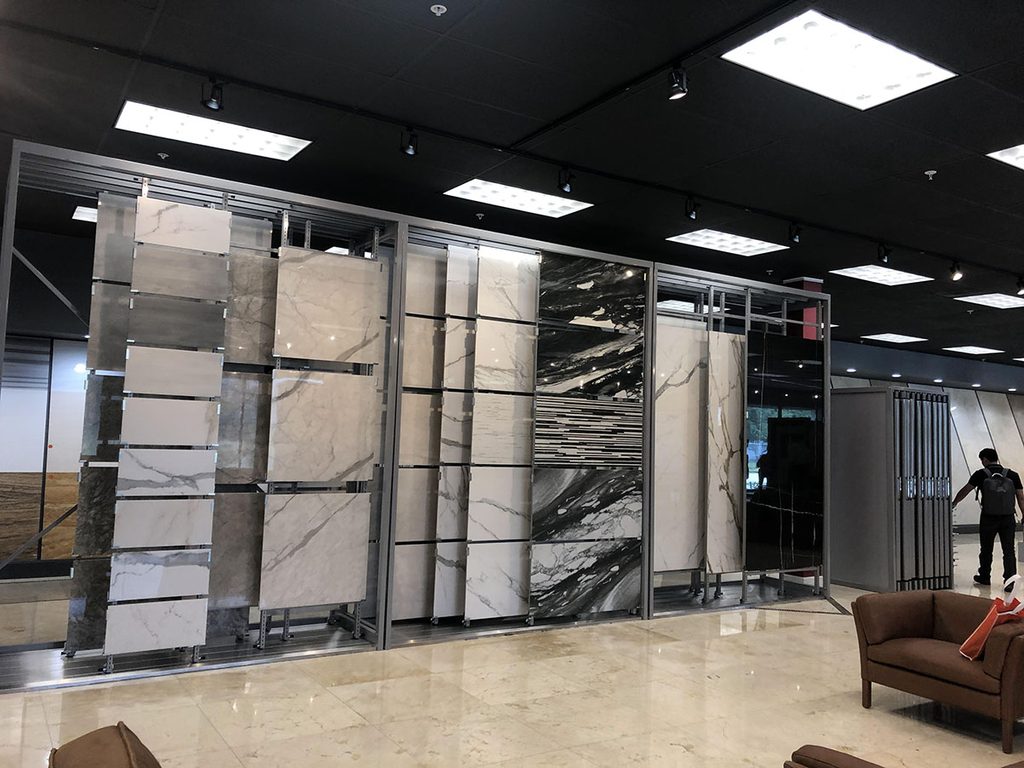
Why do sliding racks feel cleaner?
Because nothing is out of place. Every sample lives on a track and returns to it. There’s no pile of loose tiles on a counter and no half-open panel blocking the aisle.
3. Multi-level tile display stands use vertical space
Tiles come in different sizes, and one rack height doesn’t fit all of them.
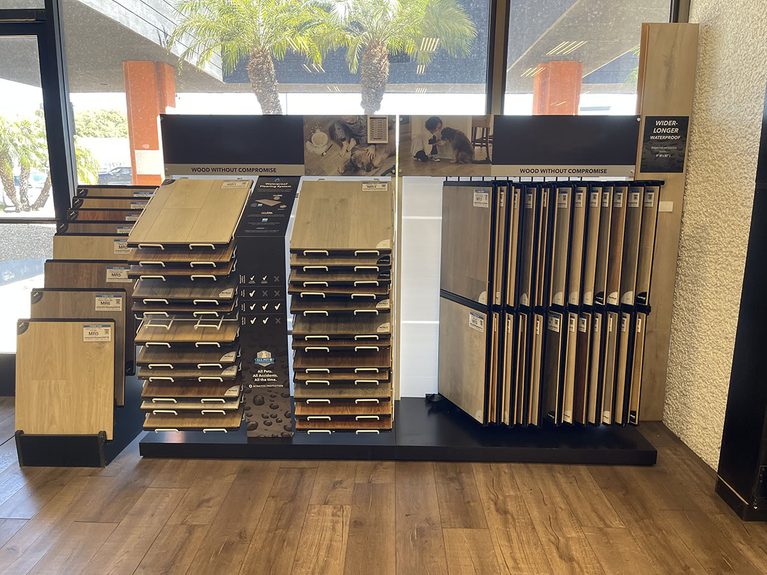
Multi-level tile display stands stack several viewing levels in one footprint. Ceramic, porcelain, bathroom, kitchen, and decorative tiles each get their own row, all at eye level instead of forcing customers to bend down to a bottom shelf.
What tile sizes fit a multi-level rack?
| Tile type | Typical sizes | Best display |
|---|---|---|
| Ceramic wall tiles | 300×600 mm | Multi-level stand |
| Porcelain floor tiles | 600×600 mm | Sliding rack |
| Large format slabs | 1200×2400 mm+ | Heavy-duty slab rack |
| Mosaics and small samples | 25×25 mm sheets | Sample board or binder |
4. Make it easy to compare tiles
A showroom’s real job is to shorten the decision, not just show product.
Group tiles by how customers actually shop: by application, then by style, then by size. Put bathroom and kitchen tiles together. Put wood-look and marble-look together so shoppers can compare finishes without walking the whole room.
- By application: bathroom, kitchen, outdoor, floor, wall
- By style: marble look, wood look, stone effect, minimalist
- By size: 300×600, 600×600, large format
How do customers actually pick a tile?
Most shoppers narrow by room first, then by look, then by budget. If your racks follow that same order, the customer never has to ask where the kitchen tiles are.
5. Match the display to the tile size
A rack built for mosaics will not hold a 1200 mm slab, and a slab rack wastes space on small samples. Match the fixture to the format.
Small samples
Sample boards, binders, and compact display boxes work best for ceramics, mosaics, and decorative tiles.
Mid-size tiles
Sliding racks and pull-out panels handle 600×600 and 600×1200 porcelain cleanly.
Large format slabs
Slabs need slab display stands or heavy-duty stone racks. They weigh too much for standard tracks.
6. Light the tiles, not the room
Lighting decides whether a marble tile looks premium or just gray.
Poor lighting flattens texture and shifts color, so a customer who loves the tile in the showroom hates it on their floor. Use focused light on glossy finishes, marble patterns, and surface textures. Use color-accurate lighting on everything else so the sample matches what they’ll install.
What color temperature shows tile accurately?
Cool white, around 4000 to 5000K, keeps whites and grays honest. Warmer light distorts them. If you sell a lot of stone and marble, test your fixtures against daylight.
7. Keep the showroom minimal
Small spaces punish clutter more than big ones do.
Stick to one or two rack styles, neutral wall colors, and clean lines. The tiles should be the visual noise, not the displays. When every rack matches, the room reads as a system, and a system feels more professional than a collection of mismatched stands.
What should you cut first?
Skip the extra decorations and mixed display styles. They read as clutter in a small room and pull attention from the product.
8. Custom tile display racks for small showrooms
Off-the-shelf racks don’t always fit, and in a small room, close enough wastes real money.
A custom tile display rack is built to your floor plan, your tile dimensions, and your brand. You can specify rack size, color, logo printing, and materials, and design it modular so it grows with a new collection.
Why do brands and distributors bother?
Because the same custom rack in every store gives a franchise a consistent look, and consistency is part of the brand.
| Requirement | Off-the-shelf | Custom |
|---|---|---|
| Fit your exact floor plan | Sometimes | Yes |
| Match your brand colors and logo | Rarely | Yes |
| Handle unusual tile sizes | Depends | Yes |
| Lead time | Immediate | 2–6 weeks |
| Cost per unit | Lower | Higher |
9. Small showroom mistakes to avoid
Three mistakes come up in almost every small showroom.
Too many products at once
More samples does not mean more sales. It means more decisions, and too many decisions make customers walk out without buying. Group products into collections and show one hero piece per collection.
No room to move
If two customers can’t pass each other in the aisle, the layout is wrong. Leave clear paths between racks and room to step back from a panel.
The wrong rack for the tile
A rack rated for small tiles will sag under slabs. Pick the fixture by the weight and size of what’s going on it.
10. Recommended display racks by need
| Showroom requirement | Recommended solution |
|---|---|
| Limited floor space | Wall-mounted tile racks |
| Many tile samples | Sliding tile display racks |
| Premium collections | Customized display stands |
| Large format tiles | Heavy-duty slab racks |
| Small samples | Sample boards and binders |
| Flexible layout | Mobile display units |
Frequently asked questions
What is a tile display rack?
A tile display rack is a retail fixture that holds tile samples at viewing height so customers can compare colors, patterns, and sizes in a store or showroom.
How many tiles can a sliding display rack hold?
It depends on the panel size and track length, but a typical sliding rack holds two to four times as many panels as a fixed display in the same floor space.
What is the best display rack for a small tile showroom?
Wall-mounted racks and sliding systems are best for small showrooms because they add sample capacity without taking floor space. Rotating stands work well at the entrance and in the center.
Can you use one rack for different tile sizes?
Multi-level stands handle a range of small and mid-size tiles, but large format slabs need a dedicated heavy-duty rack. Mixing formats on one fixture usually wastes space.
What lighting is best for a tile showroom?
Color-accurate lighting in the 4000 to 5000K range, plus focused spot lighting on textured and glossy finishes, shows tile color and surface detail most accurately.
How much space should I leave between display racks?
Leave at least 900 to 1200 mm between rows so two customers can pass and shoppers can step back to view a full panel.
Are custom tile display racks worth the cost?
For brands and multi-store distributors, yes. Custom racks fit the floor plan and reinforce a consistent brand image. For a single small store, start with modular off-the-shelf racks and upgrade as needed.
Conclusion
A small tile showroom doesn’t need more square meters. It needs better use of the ones it has.
Wall-mounted racks, sliding systems, and multi-level stands put more product in front of the customer without crowding the floor. Group tiles the way people shop, light them properly, and keep the room minimal, and a small showroom will outsell a messy big one.
If you’re planning a showroom, send us your floor plan and tile sizes. We’ll spec the rack layout for the space you have, not the space you wish you had.