Tile Display Rack Materials Compared: MDF, Plywood, Steel, Acrylic and PVC
Ask five suppliers what a tile display rack is made of and you get the same three words back: board, frame, hardware. The frame gets all the attention in photos. The board is where the money actually goes, and it is almost always the thing that fails first — swelling along an edge, sagging in the middle of a shelf, or going soft around a screw after the third time the unit was taken apart for a trade show.
This guide compares the five materials that account for almost every tile, stone, mosaic and flooring display on the market: MDF, plywood, steel, acrylic and PVC. What each one costs, what it carries, how long it lasts, and — more usefully — where each one is the wrong choice.
The short answer
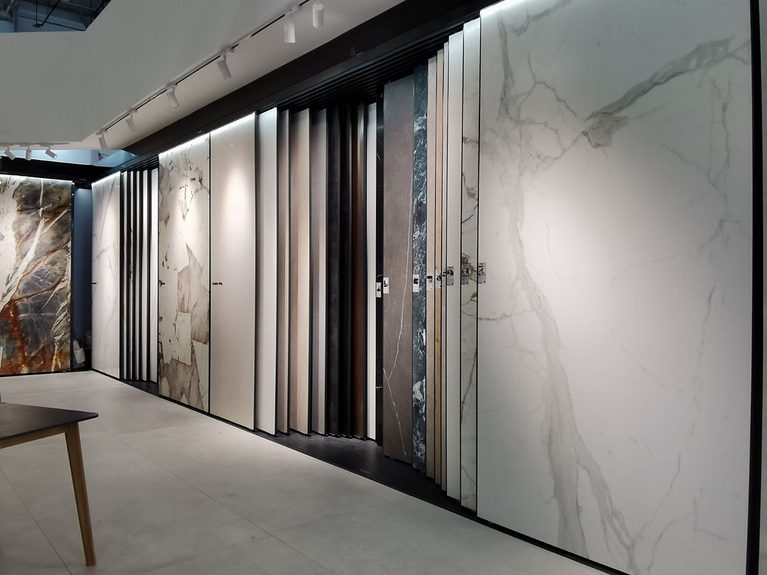
For a dry indoor showroom, the workhorse combination is a steel or aluminium frame carrying 5 to 12 mm MDF panels. Move to plywood wherever a panel has to carry real load or gets dismantled and rebuilt repeatedly. Use acrylic for small mosaic and premium samples where you want the material to look like glass without the breakage risk. Use PVC foam board in bathrooms, sanitary ware areas and any humid climate. And use solid steel — nothing else — for slab racks and outdoor stone yards.
Almost no project is single-material. A typical showroom wall is a steel tube frame, MDF boards, aluminium edge trim and ABS corner caps, and that hybrid exists for a reason we will get to.
The five materials side by side
| Material | Cost index (MDF = 1.0) | What it carries well | Weak spot | Service life, indoor retail |
|---|---|---|---|---|
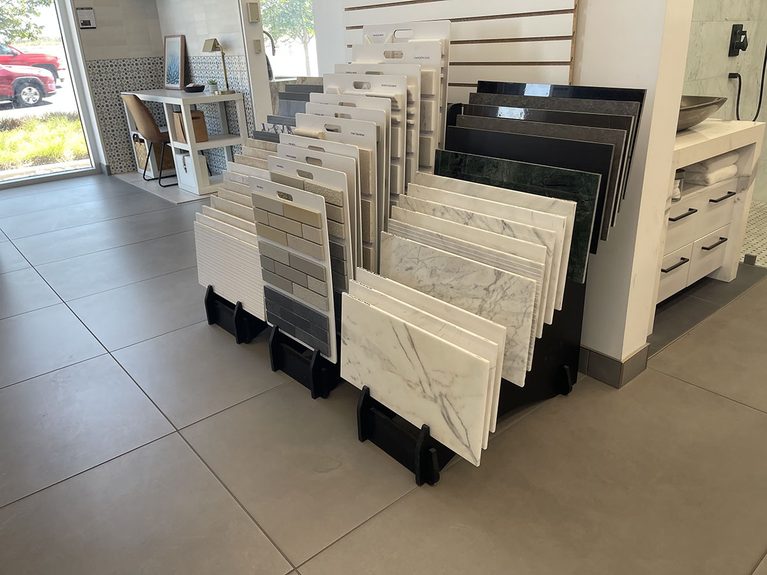
| MDF / HDF | 1.0 | Light ceramic and mosaic samples, sample boards, page-turning panels | Water swelling; screw threads strip after repeated assembly | 5–8 years fixed in place |
| Plywood (multi-layer) | 1.3–1.6 | Loaded shelves, pull-out racks, anything shipped flat and rebuilt | Visible edge needs banding; costs more per panel | 8–12 years, survives re-assembly |
| Steel / iron frame | 1.8–3.0 | Slabs up to several hundred kilos, outdoor yards, high-traffic retail | Freight weight; rust if coating is thin | 10–15+ years |
| Acrylic | 2.0–3.5 | Mosaic sheets, small premium samples, backlit displays | Scratches, static dust, yellowing under UV | 5–8 years |
| PVC foam / plastic | 0.6–0.9 | Bathroom and sanitary ware samples, humid climates | Heat distortion; low screw holding | 4–7 years |
Those indices are relative, not prices. A standard six-panel pull-out unit and a heavy steel slab rack do not differ by 1.8 times — they differ by roughly three. Material choice is one input; the other is how much of it you need.
MDF: the default, and why it usually wins
Medium-density fibreboard is wood fibre broken down and pressed back together with resin. There is no grain, so it does not have a direction, does not tear out when you cut a slot into it, and holds paint and laminate without showing a pattern through. That uniformity is exactly what a display board needs: a 300 × 300 mm panel with a routed groove has to end up flat to within a millimetre, on every single unit in a hundred-store rollout.
Our own sample boards run from 3 mm up to 15 mm, with 5 mm and 9 mm covering most of what buyers order. A 300 × 300 mm porcelain tile weighs roughly 2 kg, so on a countertop board the panel is not being asked to do much — which is why cheap MDF performs fine there for years.
The failure mode is water, and it is not subtle. MDF that takes on moisture swells at the exposed edge first, because the machined edge is bare fibre with no protection. It does not shrink back. Once a panel has swollen 2 mm you cannot hide it behind trim, and the slot that used to grip a tile now lets it rattle.
The second failure mode is mechanical and gets overlooked: MDF has poor screw-holding in withdrawal. A unit assembled once in a showroom and never touched is fine. A unit that gets knocked down for four trade shows will have loose cams and stripped screw holes by the third.
Use MDF for fixed walls, sample boards, page-turning panels, countertop stands, booking displays — anything indoor, dry and assembled once. Do not use it on a floor within splashing distance of a sink, in an outdoor stone yard, or anywhere the display travels.
Plywood: pay the premium where the load is
Plywood is veneers glued crosswise, so each layer’s grain runs perpendicular to the one below. That is why it holds screws far better than MDF, resists warping across a wide span, and survives being taken apart. For a pull-out rack holding a stack of 12 mm stone samples, 15 to 18 mm plywood shelves are the honest answer; the same shelf in 15 mm MDF will bow in a season.
It costs 20 to 40 percent more per panel, and it has two cosmetic problems. The cut edge shows the plies, so it must be banded or trimmed, and it never looks as clean as painted MDF. If the panel face is visible, expect to spend the difference on edge treatment.
Where plywood earns its money: loaded pull-out racks, waterfall and cascading displays, sample flight cases, van-mounted displays, and any unit specified to be shipped flat-packed and rebuilt by a distributor who has never seen one before.
Steel and iron frames: the part that holds the whole thing up
Nearly every rack we build uses a cold-rolled steel tube frame. The tube is acid pickled to strip mill scale, phosphated, then finished — either baked enamel or electrostatic powder coating. Standard colour is white; the finish is the same one that keeps a rack looking new in a dusty stone yard after six years.
Tube wall thickness is the number nobody asks about and everybody regrets. 1.2 to 1.5 mm is the working range for retail frames. Below 1.0 mm the frame flexes visibly when a customer leans on it, and flexing frames crack coatings at the welds.
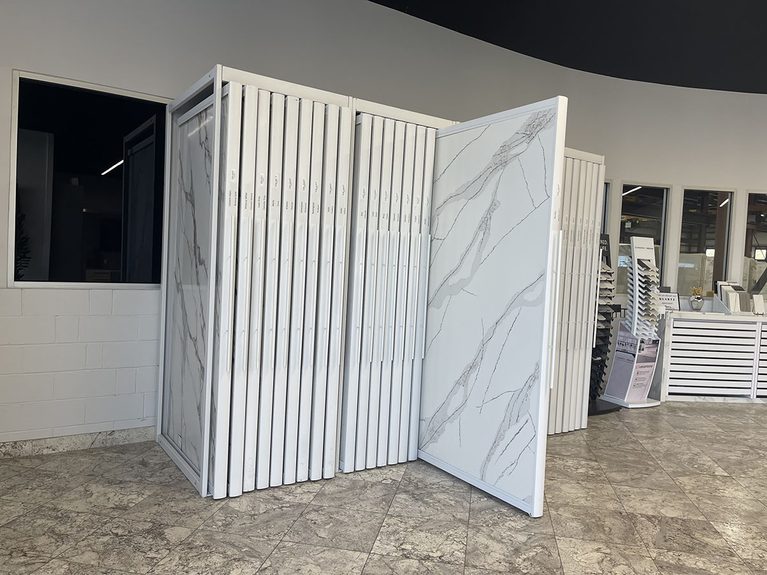
For outdoor and slab applications the specification changes completely: galvanised steel, multi-layer anti-UV powder coat, drainage holes in the base rails so water cannot pool, and ground-anchoring plates. Our outdoor slab racks are rated 300 to 800 kg per slot, which is the range needed for jumbo porcelain at 3200 × 1600 mm — and that rating is a function of the frame, not the board.
The trade-off is freight. A frame that carries forty ceramic samples might weigh 25 to 40 kg on its own. Sea freight quotes on both cubic metres and kilos, and on the heavy end the kilos win. A steel-heavy design can be the cheaper rack and the more expensive delivered unit at the same time.
Acrylic: for small samples and the premium corner
Cast acrylic in 3 to 5 mm panels, edge-polished, gives you glass clarity with no shatter risk — relevant when the display is at hip height in a showroom with children in it. It takes printed graphics on the reverse face, hooks, and slots, which makes it the natural material for mosaic sheets and small stone samples that need to be looked at close up.
Two specifications matter more than buyers expect. Cast versus extruded: extruded sheet is cheaper and scratches if you look at it firmly; cast sheet resists crazing and machines cleanly. And cleaning agents: ammonia-based glass cleaner will craze acrylic over months. Tell the cleaning contractor, in writing, or accept foggy panels a year from now.
Acrylic also attracts dust through static. In a showroom with a lot of foot traffic and no humidity control, a clear acrylic wall can look grubby by Friday no matter how often it is wiped.
PVC foam board: the material for wet rooms
PVC foam board is the cheapest board on this list, it is waterproof, it is light enough that a whole sanitary ware display can be moved by one person, and it prints and routes well. In bathrooms, shower showrooms and any market where the air conditioning is off and the humidity is not, it is simply more appropriate than MDF.
Its limits are heat and holding power. A PVC panel left in a closed car, or mounted beside a west-facing window, will creep out of flat. Screws pull out of it more easily than out of plywood, and long unsupported spans sag. Use it for sample boards and light shelving, not for a floating shelf carrying stone.
Why almost every rack is a hybrid
A steel frame carrying MDF boards with aluminium edge trim is not a compromise — it is the correct answer to a specific problem. The MDF gives you a flat, cheap, printable, routed surface. The steel gives you stiffness and a load path to the floor. The aluminium trim covers the bare MDF edge, which is the exact surface that swells first.
The rule we give buyers is: spend on the points a customer touches and on the points that carry load. Nobody runs a hand along the inside of a cabinet, so a cheaper board there is invisible. Everyone runs a hand along the front edge of a shelf, so that edge should be trimmed, banded or capped.
Matching material to the actual job
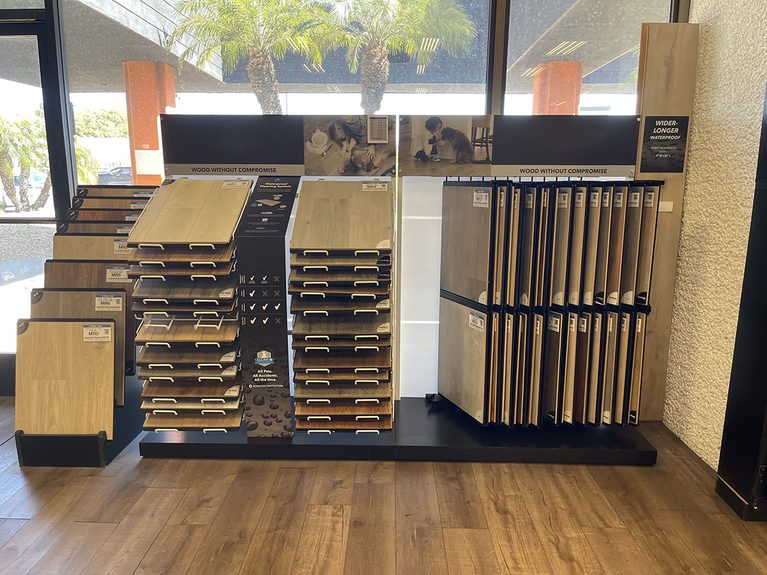
Flagship indoor showroom. Steel frame, 9 to 12 mm MDF panels, aluminium trim. Best balance of appearance, cost and flatness. See our tile display racks for the frame styles.
Multi-store rollout for a distributor. MDF with aluminium or PVC edge banding, flat-packed, hardware bagged per unit. The marginal cost of the trim pays for itself the first time a store assistant dries a shelf with a wet cloth.
Trade shows and roadshows. Plywood panels in a collapsible steel frame, or an aluminium sample case for small-format work. Ten assemblies is normal for a roadshow unit; MDF will not survive ten.
Bathroom and sanitary ware. PVC foam board with stainless hardware. Our sanitary ware display racks are built this way for exactly this reason.
Stone yard, outdoor. Galvanised steel only, no wood at all. Wood in a stone yard goes from “budget saving” to “replacement order” inside two rainy seasons. Compare our natural stone display racks.
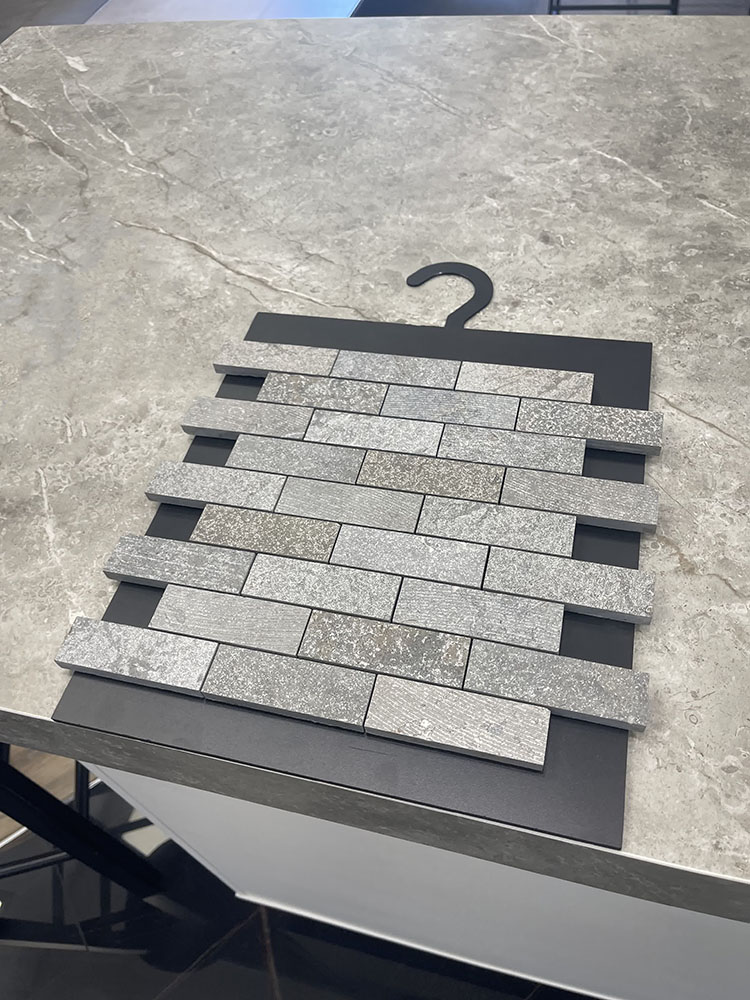
Mosaic and premium samples. Acrylic panels, 3 to 5 mm, edge-polished, optionally backlit. See the mosaic display range.
What actually moves the price
Board thickness is a smaller factor than most buyers assume. In descending order of impact, the things that change a quote are: hardware (drawer slides, gas struts, casters and locks cost more than the board they are attached to), finish (melamine is cheap, lacquer and PVC film are not), edge treatment, packing method, custom colour matching to a Pantone reference, and quantity.
Which is the reason cheap racks fail at the hardware rather than the board. A stamped slide that loses its detent in year two turns a working display into a rack nobody opens, and the tile range behind it stops selling.
Six mistakes worth avoiding
- Comparing quotes per unit without asking for kilos and cubic metres per set. Two racks at the same price are not the same delivered cost.
- Specifying MDF on a ground-floor display beside an entrance, where rain follows customers in.
- Undersized tube — under 1.2 mm — on anything holding stone or slabs.
- Acrylic cleaned with ammonia glass cleaner, then wondering why the panels went cloudy.
- Untreated MDF edges in a humid market. Fifty cents of trim per board prevents the whole problem.
- Forgetting the sample thickness. A 10 mm porcelain tile will not sit in a slot cut for 8 mm, and no material choice fixes a geometry error.
Material samples before you commit
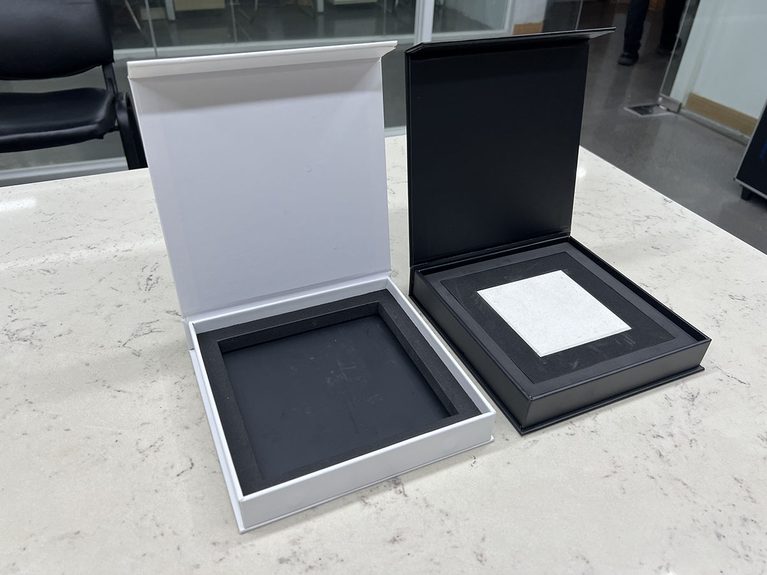
Colour and finish do not survive a screen. If you are specifying a rollout, ask for physical samples of the actual board — MDF with the exact laminate, plywood with the edge banding, an acrylic offcut, a PVC panel — alongside the frame in the specified coating. It is a small parcel and it prevents a container-load dispute.
Related reading: how to choose the right tile display rack, porcelain slab display racks, and importing display racks from China.
Frequently asked questions
Which material is best for tile display racks?
For dry indoor retail, a steel frame with 5 to 12 mm MDF boards. For loaded shelves and units that get rebuilt, plywood. For slabs and outdoor yards, galvanised steel. For bathrooms, PVC foam board. Most projects combine two of these rather than choosing one.
Is MDF strong enough for a tile display?
Yes, for individual ceramic and mosaic samples on boards and countertop stands. A 300 × 300 mm porcelain tile weighs about 2 kg. MDF becomes the wrong choice when the panel carries stacked samples over a wide span, or when it lives in a damp place.
What board thickness should I specify?
3 to 5 mm for small sample boards where weight matters, 9 mm for showroom wall panels, 12 to 15 mm for shelves and loaded panels, 15 to 18 mm plywood for heavy pull-out racks.
Can MDF be used in a bathroom showroom?
Only with a fully sealed edge and a moisture-resistant grade, and even then PVC foam board is the better answer. The humidity in a working bathroom display is constant, and MDF swelling is irreversible.
Steel or aluminium frame?
Steel for load and stiffness, aluminium where weight and corrosion resistance matter more than rigidity — portable cases, travel units, coastal sites. Aluminium is roughly half the weight and roughly half the stiffness.
How much does material choice change the price?
Swapping MDF for plywood adds roughly 20 to 40 percent to the panel cost. Moving from an MDF countertop stand to a full steel slab rack roughly triples the unit price, because the structure changes, not just the material.
Does the material affect shipping cost?
Yes, sometimes more than unit price does. Sea freight is charged on cubic metres and kilos. A steel-heavy rack that saves 15 percent on price but adds 20 kg and 0.1 m³ per set can cost more landed than the lighter alternative.
What about a display that has to travel to trade shows?
Plywood panels in a collapsible steel frame, or an aluminium flight case for small-format samples. Prioritise joint design and hardware over board quality — repeated assembly is what destroys travel units.
Specifying your rack
Send us three things and the material question usually answers itself: the sample size and thickness, the wall or floor space available, and where the unit will live — indoor showroom, wet area, outdoor yard or a van. From those we can propose a frame, a board and a finish, and quote it with the weight and packed volume so you can compare it honestly against another supplier. Start with our contact page, or browse the full product range.