Showing 901–920 of 2795 resultsSorted by latest
-
Carpet showrooms face a unique issue: samples need to be touched. The CF2009 presents samples at hand height with enough clearance for customers to feel the pile, check the backing, and return the sam
-

Designers and architects are the primary mosaic customer, and they make decisions based on subtle color differences. The MT922 positions samples at eye height with uniform lighting exposure.
-

We manufacture the SG2018 with frame tolerances borrowed from industrial pallet racking. Not because display stands belong in warehouses, but because wobbling is unacceptable when presenting a $3,000
-

Natural stone slabs are heavy, irregular, and expensive to replace. The SRL151 was engineered around those realities — load-tested to 120kg per slot with a safety factor of 2.5.
-


Stone showrooms face constant tension: display more products to sell more, but do not overcrowd the space. The 941 uses a staggered front-to-back layout that shows every slab face from a single aisle.
-

The 086 was first prototyped for a Dubai-based stone importer who needed display racks that could survive in 45°C warehouse heat without the powder coat peeling. That prototype is still in service 4 y
-
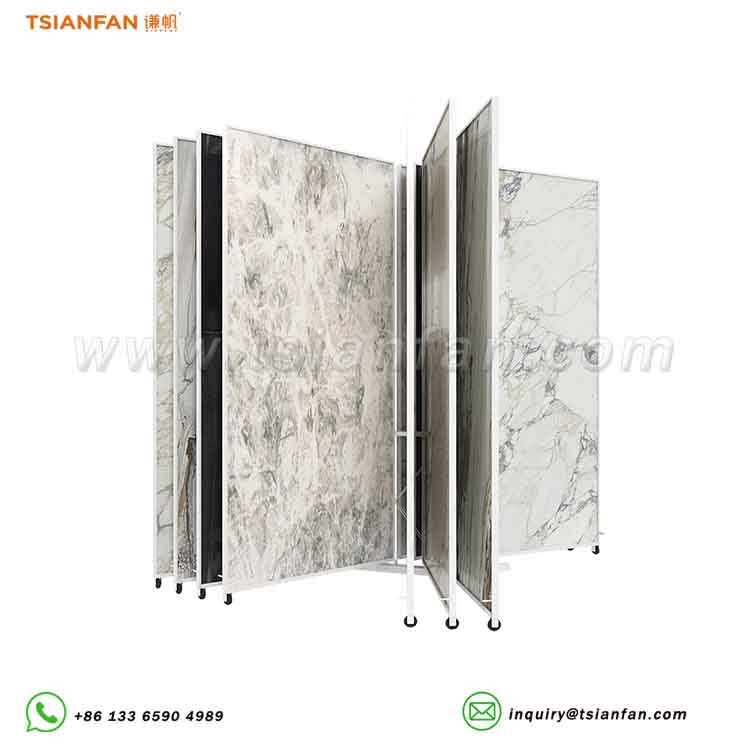
The SD2003 frame uses CNC-welded joints throughout — every structural connection is a continuous weld bead, not a bolt and washer. This doubles the load rating compared to bolt-together designs.
-

Quartz, granite, and marble each have different weight characteristics. The SG2010 slot geometry was optimized for the average density range of natural and engineered stone, with extra reinforcement a
-
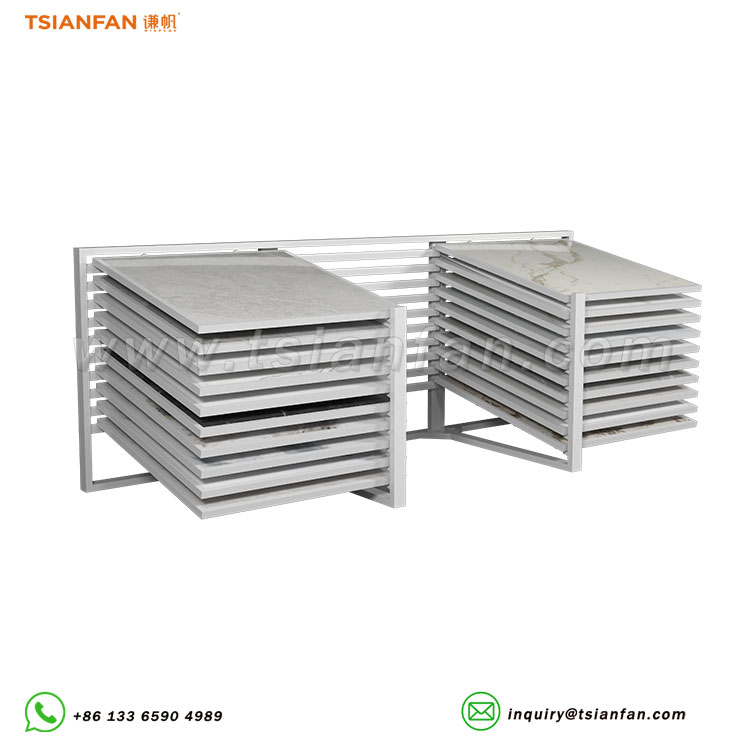
The SG2015 contact pads are made from EPDM rubber — the same material used in permanent outdoor gaskets. They won’t degrade, stain, or transfer color to light-colored stone surfaces.
-

Humidity in stone warehouses can be extreme. The SG2019 powder coat is applied at 90-110μm thickness — more than triple the industry minimum — with a zinc phosphate undercoat for corrosion resistance.
-

We manufacture the SG2022 in the same facility where we build industrial storage systems, which is why the load ratings on our display racks are conservative rather than aspirational.
-

The SG2025 frame uses CNC-welded joints throughout — every structural connection is a continuous weld bead, not a bolt and washer. This doubles the load rating compared to bolt-together designs.
-

We engineered the SG2027 center of gravity 40% below the frame midpoint after studying how customers interact with stone displays. They lean slabs forward to see the polished face, and the rack must n
-

The DESIGN frame uses CNC-welded joints throughout — every structural connection is a continuous weld bead, not a bolt and washer. This doubles the load rating compared to bolt-together designs.
-

We pre-drill and tap every threaded insert on the ST002 before finishing, so the powder coat never fills the threads. Your assembly bolts go in clean every time.
-

Natural stone slabs are heavy, irregular, and expensive to replace. The ML042 was engineered around those realities — load-tested to 120kg per slot with a safety factor of 2.5.
-

Different plank widths create display chaos in multi-brand showrooms. The WX903 accepts planks from 75mm to 300mm wide in the same frame, with tier spacing that adjusts independently per row.
-

Unlike display systems that become obsolete when you change product lines, the 454 is category-agnostic. It works equally well for hardwood, laminate, engineered wood, LVT, and bamboo planks.
-

The 112 contact pads are made from EPDM rubber — the same material used in permanent outdoor gaskets. They won’t degrade, stain, or transfer color to light-colored stone surfaces.
-

Humidity in stone warehouses can be extreme. The 251 powder coat is applied at 90-110μm thickness — more than triple the industry minimum — with a zinc phosphate undercoat for corrosion resistance.