
Anti-Scratch Demo Flow: Comparing Finishes Without Damaging
Editorial Trust Note: This article is built from public market sources and reviewed by our factory product team before publication.
Author: Tsianfan Insights (Display & Packaging Sourcing Specialist)
Reviewed by: Tsianfan Engineering Review (Product Quality & Standards Verification)
Last updated: 2026-06-29 | About | Editorial Policy | Business Disclaimer | Contact
Years of walking factory floors and showroom audits teach you a hard lesson: the most critical quality checkpoint isn’t in the production line — it’s the moment a buyer pulls a sample slab toward themselves. That single motion can chip a polished edge, scuff a honed surface, or introduce a hairline crack that voids a premium marble sale. Packaging gets samples across the ocean. The pull-out display rack is their last-mile protection inside the showroom.
What a Pull-Out Display Rack Actually Does
A pull-out rack isn’t just a storage frame. It’s an engineered presentation system that lets customers slide full-size stone or tile panels into view, inspect the surface at comfortable angles, and return them without impact. Unlike static A-frames or leaning slab displays, a pull-out mechanism isolates each sample so heavy slabs never rub against each other. The result: zero friction damage, faster comparison, and more time spent selling instead of retrieving stock from back rooms.
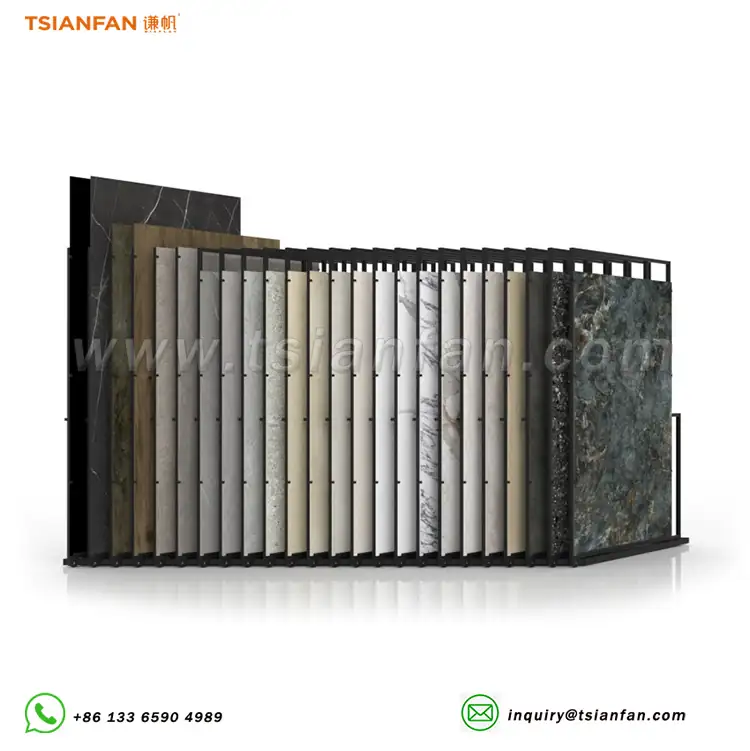
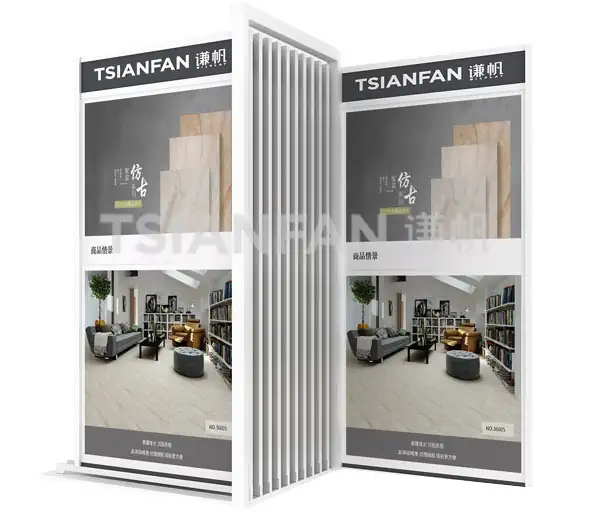
We see two distinct formats dominating floor plans. Vertical sliding racks — like the CT2173 granite sliding rack — handle natural stone slabs weighing up to 120 kg per slot. Horizontal pull-out boards — such as the CF005 tile display rack — give a gallery-like browsing experience for ceramic and porcelain planks. Both share the same core purpose: stop the silent inventory loss that happens when samples degrade before they’re sold.
Recommended Product Highlights
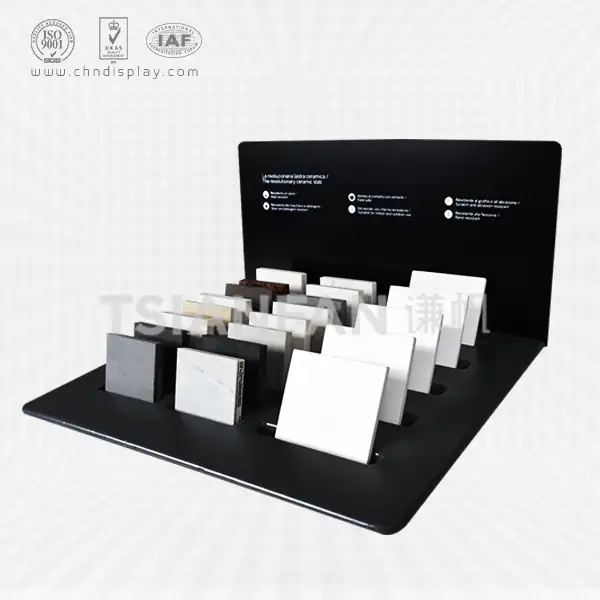
The following products are frequently selected in similar sourcing scenarios.
Why Sample Protection Is a Conversion Metric
A showroom visitor who spots a chip on a quartz sample doesn’t just put that slab back. They question the quality of the entire supplier. Pull-out racks directly address this by engineering out the contact points that cause damage. The CT012 tile push-pull rack uses dampened stainless steel ball-bearing slides so even large 1200×1200 mm porcelain panels glide out gently, locking into a viewing position without slamming into the frame. EPDM rubber pads at every sample contact surface prevent scratches and eliminate the risk of chemical reactions with sensitive marble or limestone — a common problem with cheaper PVC pads that can leave ghost stains after a few months.
The “last-mile” logic holds up: you invest in export-grade crating, plywood reinforcement, and humidity-controlled containers. At that point a weakly designed showroom stand lets a customer chip a corner during the In practice demo. The rack becomes the final guardian of your product’s perceived value.
Sliding granite display rack CT2173 — consistently top inquiry volume from stone importers and wholesale distributors across 50+ countries.
Model Comparison: Which Pull-Out System Fits Your Stock
Not every rack handles every material equally. Granite slabs need brute load capacity. Polished marble demands anti-glare angling. Large-format porcelain calls for precise slot spacing so panels never warp. The table below maps four workhorse systems from our factory floor to the materials they’re built for.
| Model | Pull-Out Type | Max Load per Slot | Key Protection Feature | Best Material Fit |
|---|---|---|---|---|
| CT2173 | Vertical sliding | 120 kg | Full-frame gussets, EPDM pads, low CG | Granite, engineered stone, thick marble |
| CF005 | Horizontal panel slide | 75 kg (distributed) | Angled viewing brackets, cross-braced rear | Ceramic tiles, mosaic panels |
| CT2131 | Push-pull rail | 75 kg | Tool-free slot adjustment, anti-sway bracing | Porcelain slabs up to 1200×1200 mm |
| 553 | Large slab slide-out | 75 kg | Zinc-phosphate anti-corrosion, floor anchors | Ceramic large slabs, exhibition samples |
Steel vs Aluminum: What the Frame Material Means for Sample Life
Material choice for the rack frame itself directly influences long-term sample safety. Lightweight aluminum racks feel convenient but introduce vibration during slide-out; over years, micro-movements cause edge chalking on natural stone. Steel dominates in commercial pull-out systems because rigidity equals protection.
| Property | Cold-Rolled Steel (CT2131, CT2173, CF005 base) | Aluminum Extrusion (alternate lightweight option) |
|---|---|---|
| Load-bearing rigidity | High — CNC-welded joints, full-length ribs | Moderate — bolt-together flex under heavy slabs |
| Corrosion resistance | Excellent with powder coating + zinc-phosphate pre-treatment | Natural oxidation layer, but risk of galvanic reaction with stone dust |
| Visual consistency | Matte black standard, RAL color match available | Silver/black anodized finishes; color match limited |
| Lifetime with high traffic | 10+ years with zero frame deformation | 5–7 years before joint loosening in humid climates |
Maintenance That Prevents a Slow Drift Toward Damage
Even the best-engineered pull-out mechanism loses its sample-protecting qualities without a simple maintenance routine. Over years of daily slide cycles, slider carriages collect stone dust, fasteners can drift, and powder coating wears at contact edges. A neglected rack slowly turns from a protective tool into a liability.
Daily and Weekly Checks
Wipe slider rails with a dry microfiber cloth each morning — stone dust acts like sandpaper between bearings and tracks. Inspect EPDM pads for embedded grit that can scratch the backside of a sample when pulled out. A quick visual scan for loose floor anchors takes 30 seconds; a wobbly rack introduces stress fractures into the very samples it’s meant to protect.
Monthly and Quarterly Tasks
Torque M8 stainless steel fasteners to spec once a month — thermal expansion in air-conditioned showrooms gradually loosens bolted joints. For ball-bearing slides on high-use racks such as the CT2131 push-pull system, apply a dry PTFE lubricant every quarter. Avoid oil-based sprays; they attract dust and become grinding paste. Check slot-to-slot spacings with a simple jig to confirm no panel is rubbing its neighbor.
Annual Deep Service and Lifecycle Cost Control
Strip the rack of samples annually, inspect powder coating under the bottom rails where moisture lingers, and recoat any chipped areas with cold zinc spray to prevent rust creep. Replace EPDM pads showing hardness — old pads lose elasticity and transfer vibration directly to stone edges. A pull-out rack that costs $1,200 to maintain properly over 10 years will save tens of thousands in sample replacement compared to a cheaper stand that ruins three quartz slabs a year. When calculating lifecycle cost, factor in the per-slot sample value: a single expensive marble book-matched panel justifies premium maintenance.
Sourcing Pull-Out Displays: Factory-Direct Advantages
Importers and wholesalers looking at stone display rack and tile display stand procurement often start with the question of MOQ and lead time. Factory-direct sourcing with flat-pack shipping — like the CT2131 or CF005, which reduce freight volume by up to 85% compared to assembled units — keeps landed cost predictable. We build pull-out racks from cold-rolled steel sourced from ISO-certified mills, with full batch traceability on structural members. No middlemen, no hidden brand licensing fees on RAL color-matched showroom schemes.
Before you confirm a bulk order, confirm three QC checkpoints: frame geometry tolerance (CNC slot accuracy ±0.5 mm on CT012 and CT2173 models), powder coat thickness (90–110 μm with zinc-phosphate pre-treatment as seen on the 553 series), and slider cycle testing (dampened stops that eliminate panel slam). A 10-minute video walkthrough of your rack on the factory floor — fully loaded with weight simulators — is standard practice here. It’s the closest thing to a test drive before the container leaves Xiamen.
Whether you’re fitting out a wholesale distributor showroom, expanding a retail tile chain, or preparing for an international trade exhibition, the right pull-out display solution turns sample presentation into a zero-damage experience. The shelf isn’t just storage — it’s the point where a buyer’s trust meets the physical product. Protect that moment, and you protect your margin.
Contact us to discuss your pull-out rack configuration or request a factory-floor video review.
Evidence & Sources
This article references the following industry sources and market materials:
- sample stone sliding display stand granite display rack-CT2173 (WP Product / Pull-out displays | 2026-05-16T04:54:41)
- Horizontal sliding large metal bracket tile board display rack-CF005 (WP Product / Pull-out displays | 2026-05-16T16:14:29)
- affordable porcelain tiles push-pull display stand-CT2131 (WP Product / Pull-out displays | 2026-05-16T14:09:05)
- Tile push-pull display rack with customized size is hot-selling-ct012 (WP Product / Pull-out displays | 2026-06-25T02:30:55)
- Ceramic tile large slab large sliding rack exhibition hall rack factory (WP Product / Pull-out displays | 2026-05-16T16:22:02)
This content is for informational purposes only and does not constitute legal, financial, or procurement advice.